What is the subscription business model?
The subscription business model means that a customer receives your product on a fixed rhythm and pays for it automatically every period, until they pause or cancel. So you are not selling a single order, but a series of deliveries. It is also simply called a subscription model.
The difference with one-off sales lies in what you know in advance. A one-off order has to be won again every time: the customer has to think of you again, find your shop again and check out again. With a subscription the next delivery is already scheduled. You can predict that revenue, but only as long as every delivery stays worth it, because the customer can stop every period.
How does a subscription model work?
For physical products, such as coffee, supplements or pet food, it starts on the product page. After the first order the rest runs by itself.
- The customer chooses product and rhythmOne-time or by subscription, and then for example every two, four or six weeks.
- The first order sets up the paymentThe customer checks out and with that gives permission for the charges that follow.
- A charge and a delivery every periodThe amount is charged automatically and an order comes in, which you ship like any other.
- The customer makes their own changesIn a customer portal they skip a delivery, pause, switch product or rhythm, or cancel.
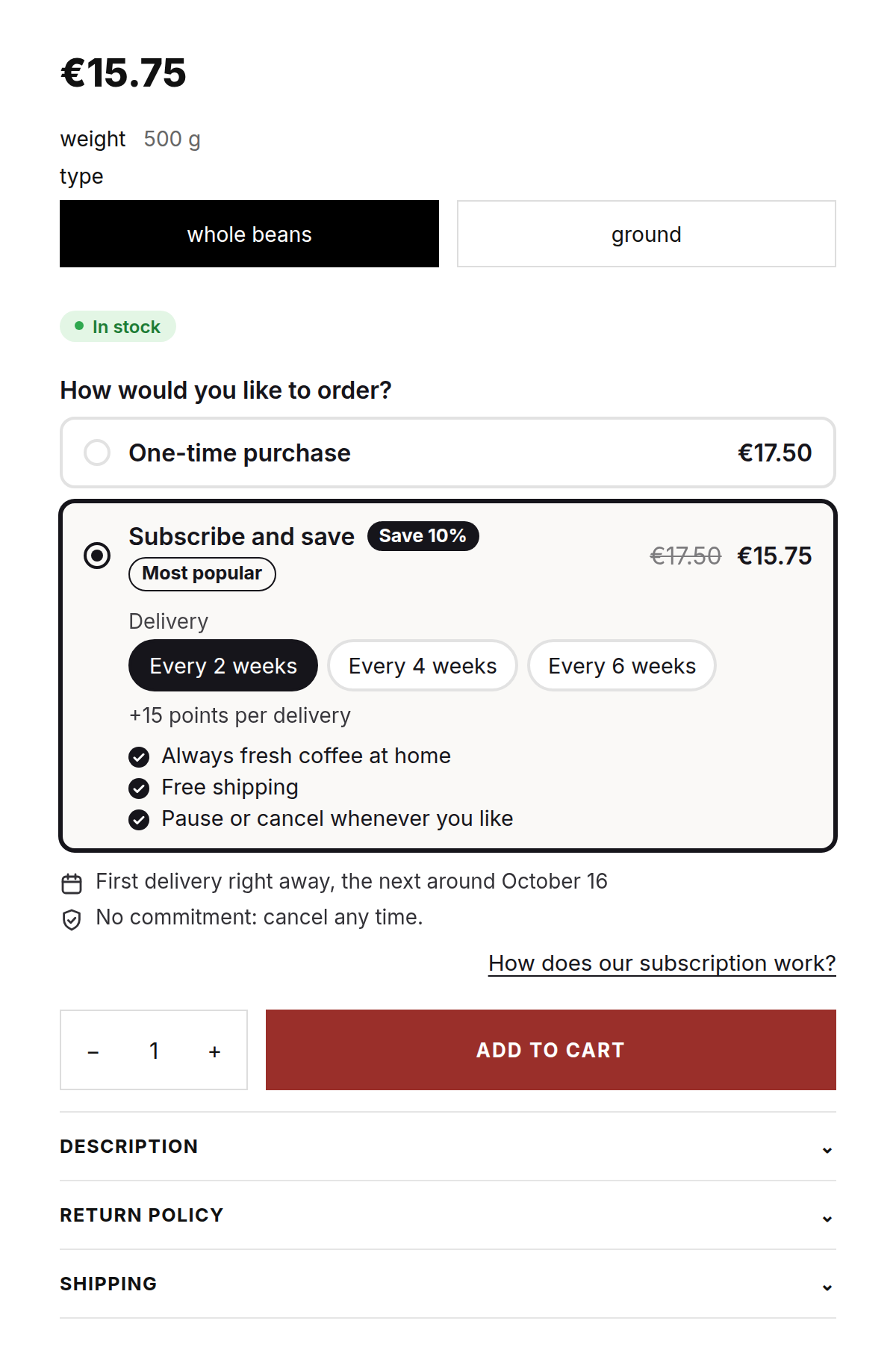
The fourth step sets a product subscription apart from a contract: someone who goes on holiday or still has stock skips a delivery instead of cancelling.
Types of subscriptions for online shops
Not every subscription is a bag of coffee a month. Five forms you come across in online shops:
| Type | What the customer gets | When it fits |
|---|---|---|
| Replenishment | The same product on a fixed rhythm: coffee, supplements, pet food | The product runs out at a predictable pace |
| Curation | A changing selection that you choose, such as a box of the month | Your range is wide and customers want to discover something new |
| Prepaid | 3, 6 or 12 deliveries, paid in one go; also as a gift | Customers want to give the subscription away or commit for a period |
| Build-your-own box | A box the customer fills with products from your range | Customers each have their own taste or combine several products |
| Business standing order | A company gets the same order on a fixed rhythm, usually on account | Offices, hospitality or practices keep ordering the same thing |
Replenishment is the simplest to start with: it needs no new product. A curated box takes buying and selection work every period. The forms can be combined, for example replenishment with a prepaid plan for the gift months.
Advantages of a subscription model
- Predictable revenue. You know in advance which deliveries are scheduled. The revenue of running subscriptions (MRR) is the floor under your month; one-off sales come on top.
- Stock and purchasing you can plan. The scheduled deliveries tell you what to buy, roast or produce.
- A customer you acquire once. With one-off sales you pay with ads or a promotion to bring the same customer back. With a subscriber the next order comes without that cost.
- More contact moments. Every delivery is a chance to let the customer try something new or to send an extra product along.
Disadvantages and risks
The model has a price. Five risks to allow for in advance:
| Risk | What happens | What you do about it |
|---|---|---|
| Churn | Every month a share of your subscribers stops; that share decides what a subscriber is worth | A rhythm that fits, and pausing and skipping next to cancelling |
| Failed payments | A charge fails because of an expired card, too little balance or a withdrawn mandate | New attempts on fixed days and a clear e-mail to the customer |
| Having to keep delivering | A late or disappointing delivery is a reason to stop | Planning stock on the scheduled deliveries |
| Margin under the discount | The subscriber discount comes straight out of your margin with every delivery | Working out the discount on margin per delivery, not on revenue |
| Consumer law | As a rule a consumer must be able to cancel easily and can withdraw from an online purchase within the cooling-off period | Making cancelling possible in the portal and putting a withdrawal function on your site |
On that last point: since 19 June 2026 a webshop in the EU must have a withdrawal function on the site, for subscriptions too. What that rule asks is in the article on the withdrawal button, among the related articles below this page. This is not legal advice.
The sums: what a subscriber is worth
Whether the model works out depends on one sum: what a subscriber brings in over the time they stay, next to what it costs to acquire them. Below is a worked example with round numbers for the fictional coffee roaster Brandpunt Koffie. The amounts are made up; the calculation is the same for every shop.
| Step | Formula | Worked example |
|---|---|---|
| Price per delivery | One-off price − subscriber discount | € 30 − 10% = € 27 |
| Deliveries per month | The rhythm, converted to a month | 1 |
| Monthly value | Price per delivery × deliveries per month | € 27 |
| Margin per month | Monthly value − cost of goods, packaging, shipping and payment fees | € 27 − € 15 = € 12 |
| Lifetime | 1 ÷ monthly churn | 1 ÷ 0.05 = 20 months |
| Customer value in revenue | Monthly value × lifetime | € 27 × 20 = € 540 |
| Customer value in margin | Margin per month × lifetime | € 12 × 20 = € 240 |
| Acquisition cost | Ads and welcome discount per new subscriber | € 60 |
| Payback period | Acquisition cost ÷ margin per month | € 60 ÷ € 12 = 5 months |
In this worked example Brandpunt Koffie keeps € 240 in margin from a subscriber who cost € 60 to acquire: a ratio of 4 to 1. The first five months go to earning back the acquisition; a subscriber who stops earlier has cost money. With a different rhythm you convert: a delivery every two weeks counts as just over two deliveries per month.
The same sum with a lower churn, at the same price, discount and costs:
| Churn per month | Lifetime | Customer value in revenue | Customer value in margin |
|---|---|---|---|
| 5% | 20 months | € 540 | € 240 |
| 4% | 25 months | € 675 | € 300 |
| 2.5% | 40 months | € 1,080 | € 480 |
One percentage point less churn brings in € 60 of margin per subscriber in this example. That is exactly what the subscriber discount costs: without the discount the margin was € 15 per delivery and the customer value at 5% churn 20 × € 15 = € 300. So a higher discount only pays for itself if it brings in subscribers who also stay. Look first at what keeps subscribers: a rhythm that fits consumption, being able to pause instead of cancel, and payments that do not fail unnoticed.
A lifetime of 1 ÷ churn assumes that the same share stops every month. In practice new subscribers tend to stop more often than subscribers who have stayed for a long time. Use a maximum, for example 60 months.
Does a subscription fit your shop?
Six questions to answer before you set anything up. The first three are about the product, the rest about your shop.
- Does the product run out at a steady pace, or does a customer build up a stock of it?
- Do customers already order the same product more than once?
- Do you know after how many weeks a customer orders again on average? That interval is your default rhythm.
- Is enough margin per delivery left after the subscriber discount, shipping and payment fees?
- Can you ship every delivery on time, in busy weeks and when stock is tight too?
- Do you earn back the acquisition cost within the time a subscriber stays on average?
If the answer to the first three questions is no, a subscription probably does not fit. A product a customer replaces once every two years does not become a subscription by putting a discount on it.
How to start a subscription box business on Shopify
On Shopify you set up subscriptions with an app, whether you sell one product on repeat or a box of several. Start with a few products, in this order:
- Choose the products and rhythmsStart with the products customers already order repeatedly. Offer two or three rhythms that fit consumption.
- Set the subscriber discountWork from your margin per delivery, as in the worked example.
- Put the subscription choice on the product pageWith the rhythm, the price and the terms next to it. Say that pausing and cancelling are possible.
- Set up the customer portal and the e-mailsDecide what customers may change themselves. Send a reminder a few days before every delivery, so the charge is not a surprise.
- Decide how customers payBy card, or by iDEAL for the first order followed by automatic direct debit. Also set how often a failed payment is tried again.
- Measure MRR and churn from day oneTrack per month the running subscriptions, the MRR, new and cancelled subscriptions and the failed payments.
Loyalo is a Shopify app in which you set up these steps. You create plans with frequencies and a discount per frequency, put the block with the subscription choice on the product page and decide what customers may change themselves in the portal. A subscription paid by card runs through the normal Shopify checkout. With iDEAL the customer pays the first order and Loyalo charges the following deliveries through a SEPA mandate in your own Mollie account. Prepaid plans with a gift option and a box the customer puts together themselves can be set up there too.
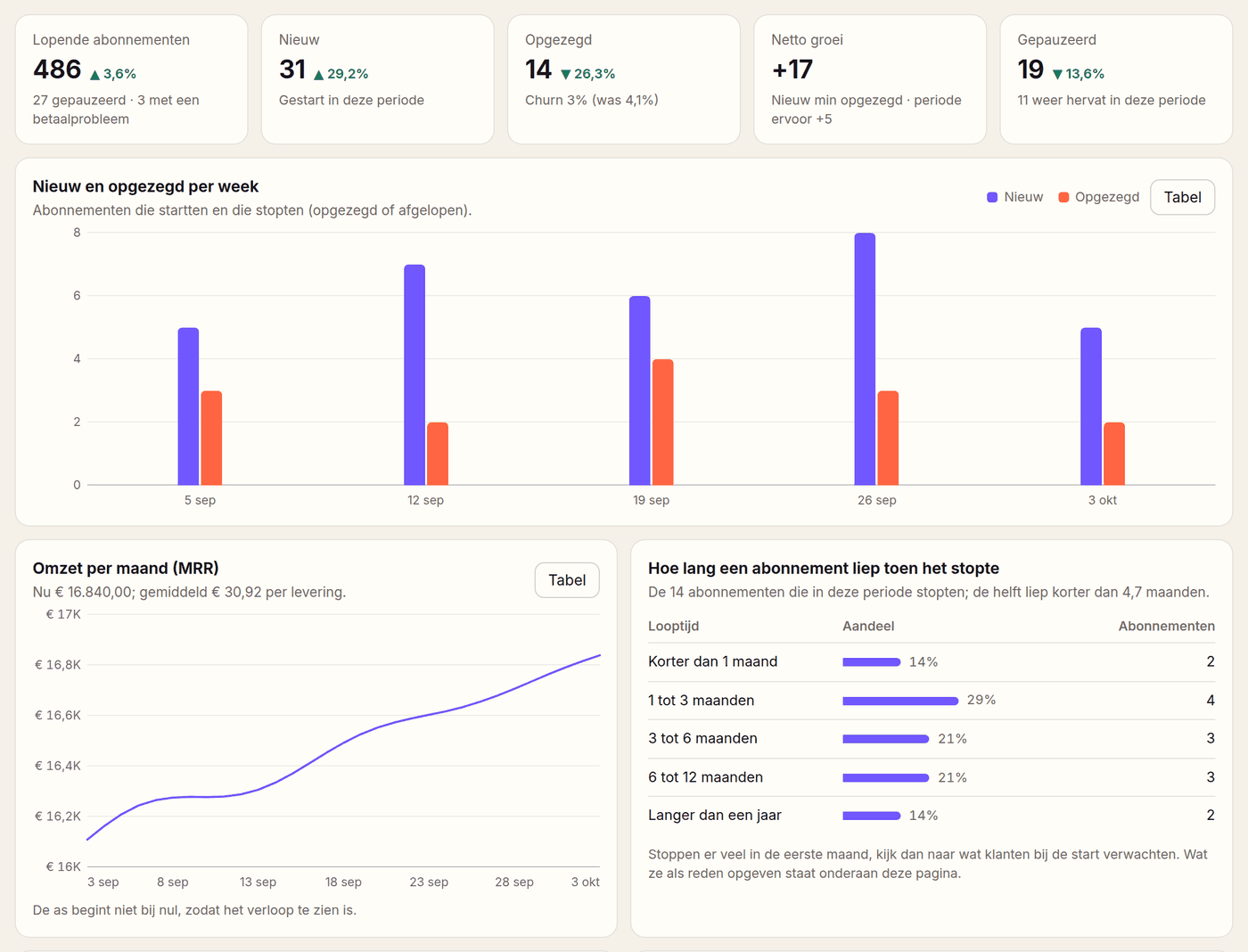
Subscriptions are in every plan: Growth costs € 99 per month up to 250 active subscriptions, Scale € 299 above that. You pay nothing per order and try everything free for 14 days.
Common mistakes
- Offering a subscription on a product that does not run out, and trying to make up for that with a discount
- Choosing the discount by feel, without working out the margin per delivery
- One rhythm for everyone, so customers build up a stock and stop
- Making it hard to cancel, while as a rule a consumer must be able to cancel easily
- Only looking at churn and failed payments once growth stalls
Frequently asked questions
What is a subscription model?
A subscription model is a business model in which a customer takes a product or service on a fixed rhythm and pays for it automatically every period, until they pause or cancel. For an online shop that means deliveries of physical products, such as coffee every four weeks.
What is the advantage of a subscription model?
The main advantage is revenue you can predict: you know which deliveries are scheduled. That lets you plan purchasing and stock better, and you acquire a customer once instead of again with every order.
How do subscriptions work in an online shop?
The customer chooses a product and a rhythm on the product page and pays for the first order. After that every delivery is charged and shipped automatically. In a customer portal they can skip a delivery, pause, change the rhythm or cancel.
Which products suit a subscription?
Products that run out at a predictable pace and that a customer buys again and again, such as coffee, tea, supplements, skincare, pet food and cleaning products. For products a customer rarely replaces, the model is a poor fit.
How much discount should you give subscribers?
There is no norm. Work from your margin per delivery: in the worked example a 10% discount on € 30 costs you € 3 of the € 15 margin, a fifth. Choose the lowest discount at which the subscription is clearly cheaper than ordering one-off.
What is the difference between a subscription and a prepaid plan?
With a subscription the customer pays per delivery and it runs until they cancel. With a prepaid plan they pay for a fixed number of deliveries in one go, for example 3, 6 or 12. After that it stops or renews, depending on what you set.
Can a customer always cancel?
As a rule a consumer must be able to cancel a subscription easily. A minimum term or a notice period is only possible within the legal limits, and those differ per country. This is not legal advice: put your terms to a lawyer.
Set up subscriptions in your own shop
In a demo we show how the subscription choice, the portal and the figures in Loyalo work for your shop.
Request a demo