What is customer lifetime value?
Customer lifetime value (CLV, also LTV) is what a customer brings in over the whole time they are a customer. So it is not the amount of one order, but the sum of all orders or deliveries of a customer, from the first to the last. Below, it is called customer value for short.
For a shop with repeat purchases or subscriptions this figure weighs more than the order value, because a customer pays more than once there. It decides how much you can spend to acquire a customer and where it pays to invest in retention. Below is the formula for subscriptions, for one-off orders and with margin. The amounts are worked examples; the calculation is the same for every shop.
The CLV formula
Customer value = the average value per period × the number of periods a customer stays. For subscriptions you calculate per month: the monthly value of a subscription × the lifetime in months. The lifetime follows from churn, the share of subscriptions that stops in a month: one divided by the monthly churn.
An example. A subscription is worth € 24 per month on average and 4% of subscriptions stop per month. The expected lifetime is then 1 ÷ 0.04 = 25 months and the customer value 25 × € 24 = € 600. That calculation is a simple customer value model: two figures, the monthly value and churn, predict what a customer brings in.
| Step | Formula | Example |
|---|---|---|
| Monthly value | Amount per delivery, converted to a month | € 24 |
| Lifetime | 1 ÷ monthly churn | 1 ÷ 0.04 = 25 months |
| Customer value in revenue | Monthly value × lifetime | € 600 |
| Customer value in margin | Customer value in revenue × gross margin | € 600 × 45% = € 270 |
Mind the monthly value for other frequencies. A delivery of € 20 every two weeks is not € 40 per month but just over € 43, because a month has 4.345 weeks on average. A yearly subscription of € 240 counts as € 20 per month.
Use margin, not revenue
Revenue overstates what a customer brings in. Every delivery carries the cost of goods, packaging, shipping and payment fees. What is left is the gross margin, and that is the only money that pays for acquisition, discounts and rewards. In the example the margin is 45%, so the customer value in margin is € 270. That is the amount to use when you decide what a new customer may cost.
CLV without a subscription: one-off orders
For customers without a subscription the formula works with orders: the average order value × the number of orders per year × the number of years a customer keeps buying. An example: € 38 per order × 3.2 orders per year × 2.5 years = € 304 in revenue. At a 45% margin that is € 136.80.
The hard figure is how long a customer stays. Without a subscription nobody cancels; you only notice that someone no longer orders. So choose a limit, for example twelve months without an order, and count whoever passes that limit as gone. The share of customers who order more than once in a period is a simple figure to track alongside it.
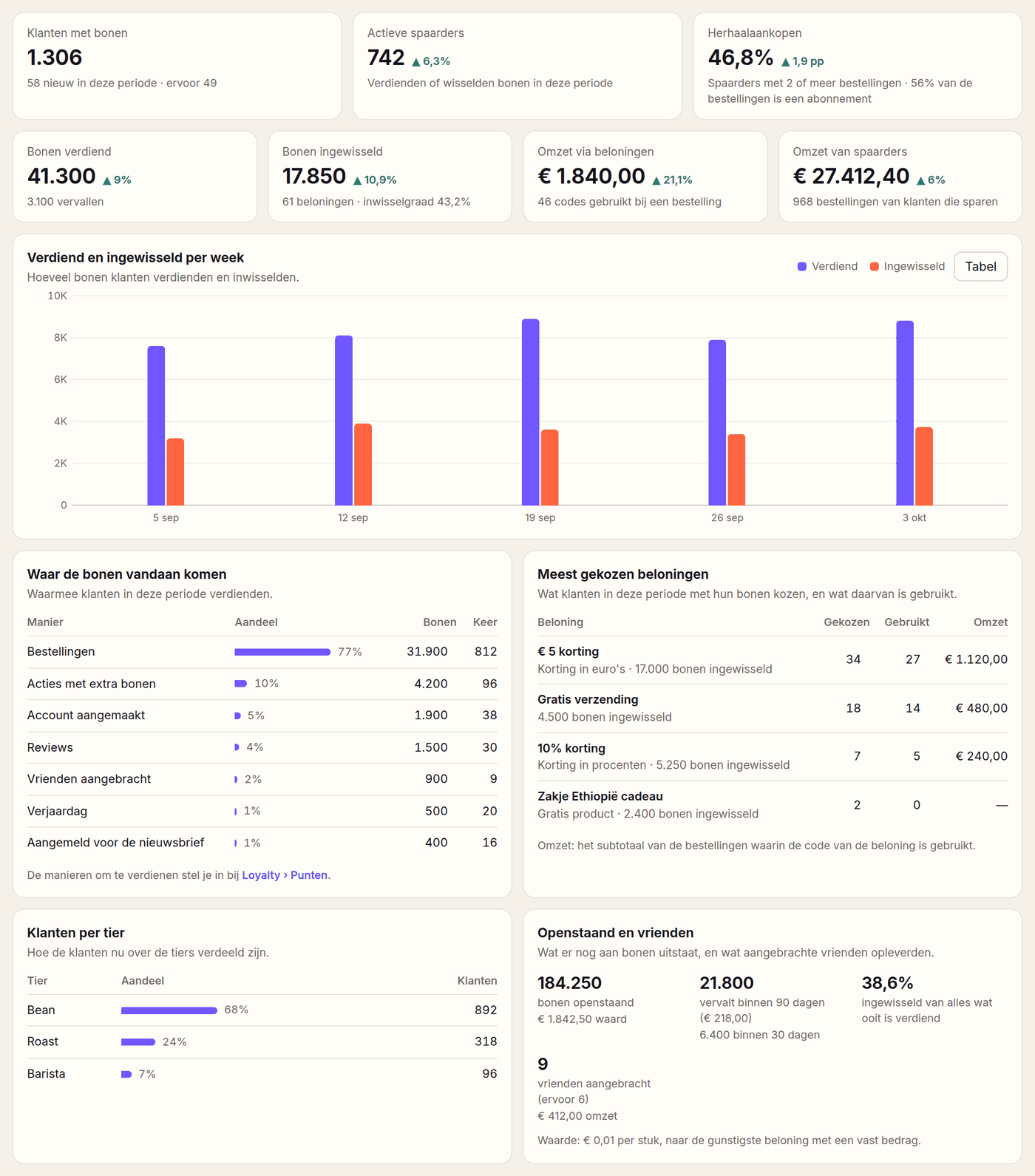
Customer value versus acquisition cost
Customer value gets its meaning next to what a new customer costs: ads, the welcome discount and any gift with the first order. Say that adds up to € 60. In the example that is set against € 270 in margin, a ratio of 4.5 to 1.
The payback period matters at least as much. The margin per month is € 24 × 45% = € 10.80, so the € 60 is earned back after 60 ÷ 10.80 = 5.6 months. If a customer stays shorter than that on average, every new customer costs money, however good the ratio looks on paper. A commonly quoted rule of thumb is that customer value should be at least three times the acquisition cost. Treat that as a starting point and check above all whether you can fund the payback period.
How to raise customer value
There are three levers to raise customer value: how long a customer stays, what they spend per month and what you keep of it. The table shows what each one does in the worked example.
| What you change | What happens | Effect in the example |
|---|---|---|
| Churn from 4% to 3% per month | Lifetime goes from 25 to 33 months | € 600 becomes € 800 |
| Monthly value from € 24 to € 27 | Same lifetime, more per delivery | € 600 becomes € 675 |
| Margin from 45% to 50% | Same revenue, more left per delivery | € 270 becomes € 300 |
Churn weighs heaviest, because lifetime is one divided by churn. One percentage point less churn adds a third to customer value in this example. You raise the monthly value with an extra product in a delivery or a larger size; the margin with purchasing and shipping costs.
Three pitfalls
- A lifetime you have never seen. At 1% churn the formula predicts 100 months, more than eight years. Use a maximum, for example 60 months.
- One average for everyone. Customers from a campaign with a high discount and customers who pay full price have a different customer value. Split by product, channel or start month where you can.
- A young base. If your programme has only been running for a few months, churn is based on few cancellations. Put the prediction next to how long stopped subscriptions actually ran.
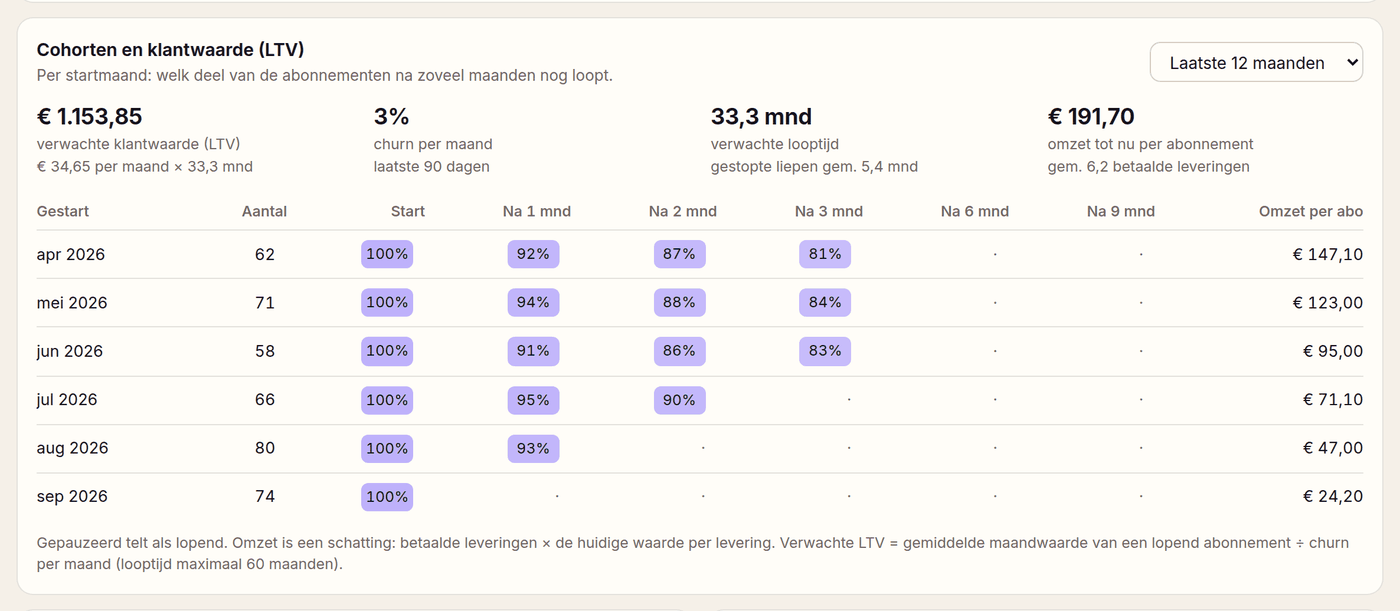
Customer value in Loyalo
The Analytics page shows the expected customer value in the cohorts section. Loyalo takes the average monthly value of a running subscription, divided by the monthly churn over the last 90 days, with a lifetime of at most 60 months. Next to it you see how long stopped subscriptions ran on average and the revenue to date per subscription. The latter is an estimate: the number of paid deliveries × the current value per delivery.
The figure is revenue, not margin. Multiply it by your gross margin yourself before you put it next to your acquisition cost. One-time extras in a delivery are not part of the monthly value.
- Convert the monthly value for weekly or yearly deliveries
- Use the monthly churn to determine the lifetime, with a maximum
- Multiply by your gross margin
- Put customer value next to your acquisition cost and work out the payback period
- Recalculate after every major change in price, discount or frequency
Frequently asked questions
How do you calculate customer lifetime value?
Multiply the value per month by the number of months a customer stays. For subscriptions the number of months is one divided by the monthly churn: € 24 per month at 4% churn gives 25 months and € 600. Multiply that by your gross margin before you compare it with your acquisition cost.
What is a good customer lifetime value?
There is no fixed norm, because the amount depends on your product, your price and your margin. Put customer value in margin next to what a new customer costs. A commonly quoted rule of thumb is at least three times the acquisition cost; also check the payback period.
What is the difference between CLV, LTV and CLTV?
None. They are three abbreviations for customer lifetime value.
Do I use historical or predicted customer value?
Both. Historical is what customers have spent so far; that figure is certain but says nothing about customers who are still running. Predicted is the formula with churn. If the two differ a lot, your churn changed recently or your base is still young.
How often do I recalculate customer value?
Per quarter is enough for most shops. The figure moves slowly, because it rests on the churn of several months. Do recalculate after a price change or a different welcome discount.
Do I include discounts?
Yes. Calculate with what the customer actually pays. A subscription discount lowers the monthly value, and a welcome discount belongs to the acquisition cost.
What if my churn is very low or zero?
Then the formula predicts a lifetime that is not realistic. Use a maximum. Loyalo calculates with 60 months at most.
Does the formula also apply to prepaid subscriptions?
Yes, but convert the amount paid to a month. Someone who pays for six deliveries up front counts per month for a sixth of that amount when delivery is monthly.
See the customer value of your own subscriptions
In a demo we show where expected customer value, churn and cohorts are in Loyalo.
Request a demo