Pause instead of stop
Pausing, resuming and moving the delivery date is something the customer does in the portal, without a ticket and without ordering again.
Read moreA cancellation is usually a request for something else: less often, later or cheaper. Loyalo offers that alternative at the moment a customer wants to stop, recovers failed payments and gives customers who stopped a reason to come back.
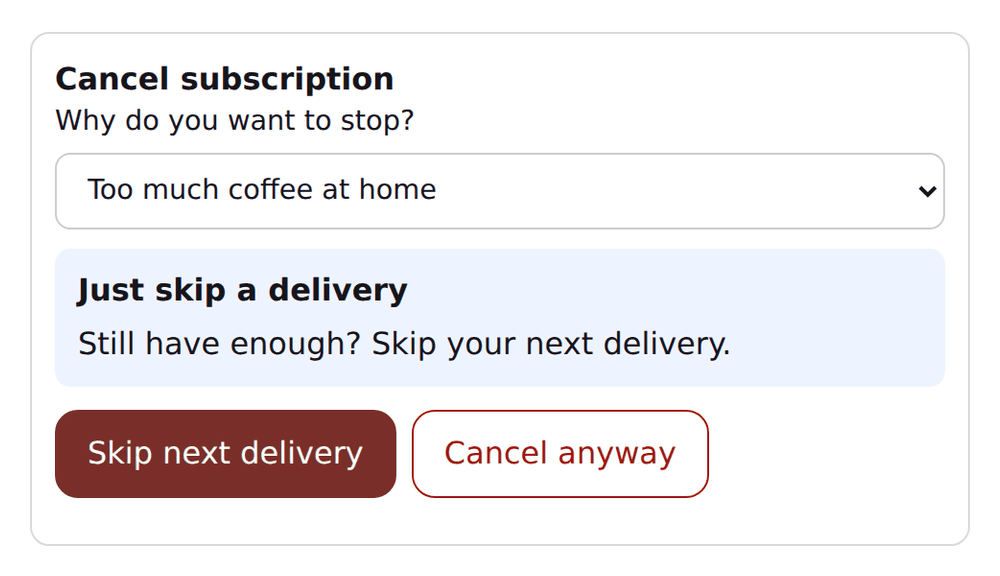
Someone with too much at home does not want a discount but a pause. Someone who finds it too expensive does not want a pause but a lower price. That is why Loyalo asks for the reason first and then makes one offer.
The customer chooses why they want to stop and sees an alternative that belongs to that reason right away. One button to take the offer, one button to cancel after all. There is no maze in between.
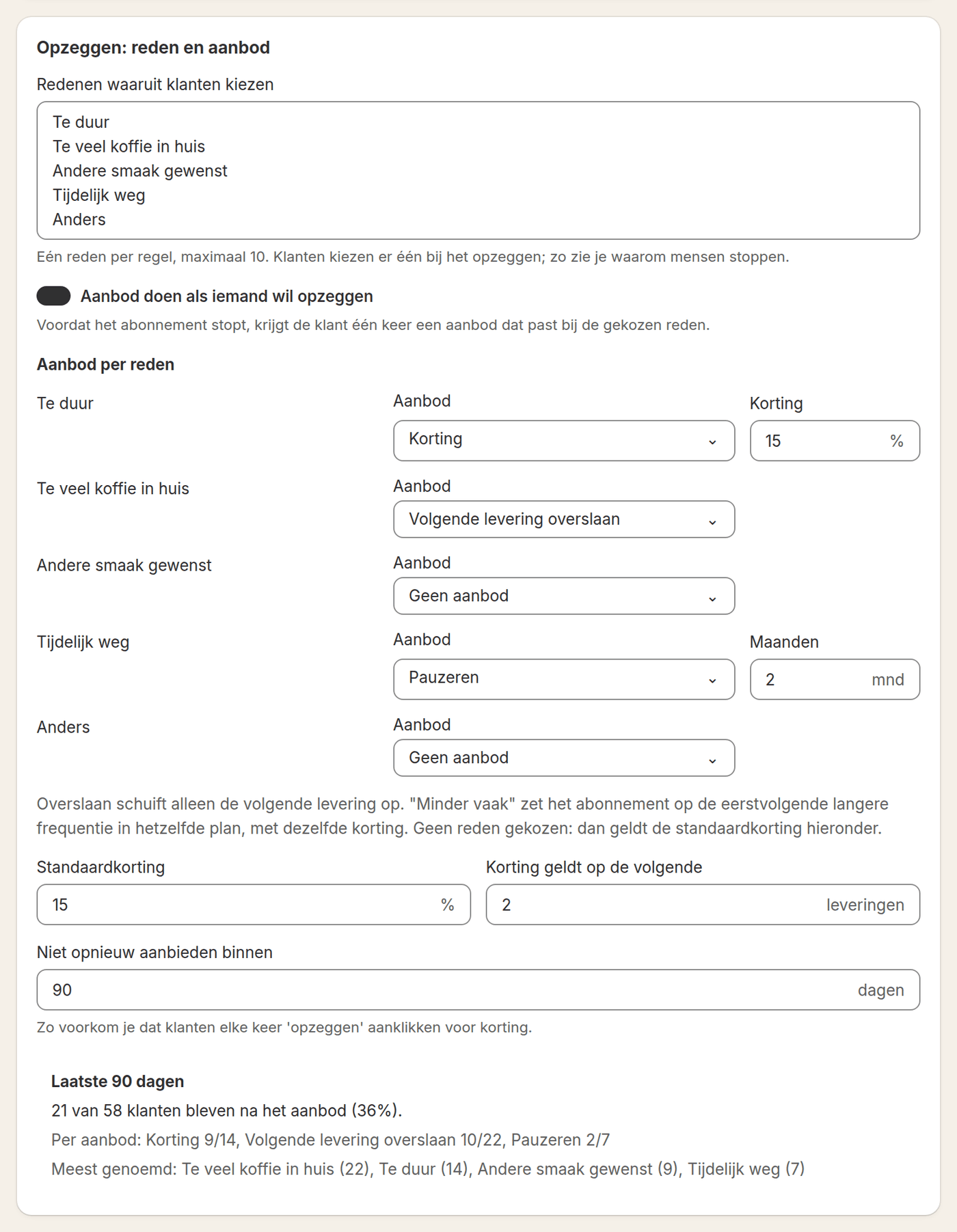
You set up to ten reasons and choose for each one what the customer is offered. Below the settings you see what it brought in the last ninety days.
In the portal, without having to call or email. You can set a minimum term and a notice period.
From the list you made, such as 'too expensive', 'too much at home' or 'away for a while'.
The offer that belongs to that reason. When they accept, the subscription continues with the discount, the pause or the new rhythm.
When the customer cancels after all, the reason is under Analytics, next to the share of customers who stayed after an offer.
Some subscribers stop without wanting to: the card expired or the balance was just too low. You solve that with a schedule of new attempts and a customer who hears about it in time.
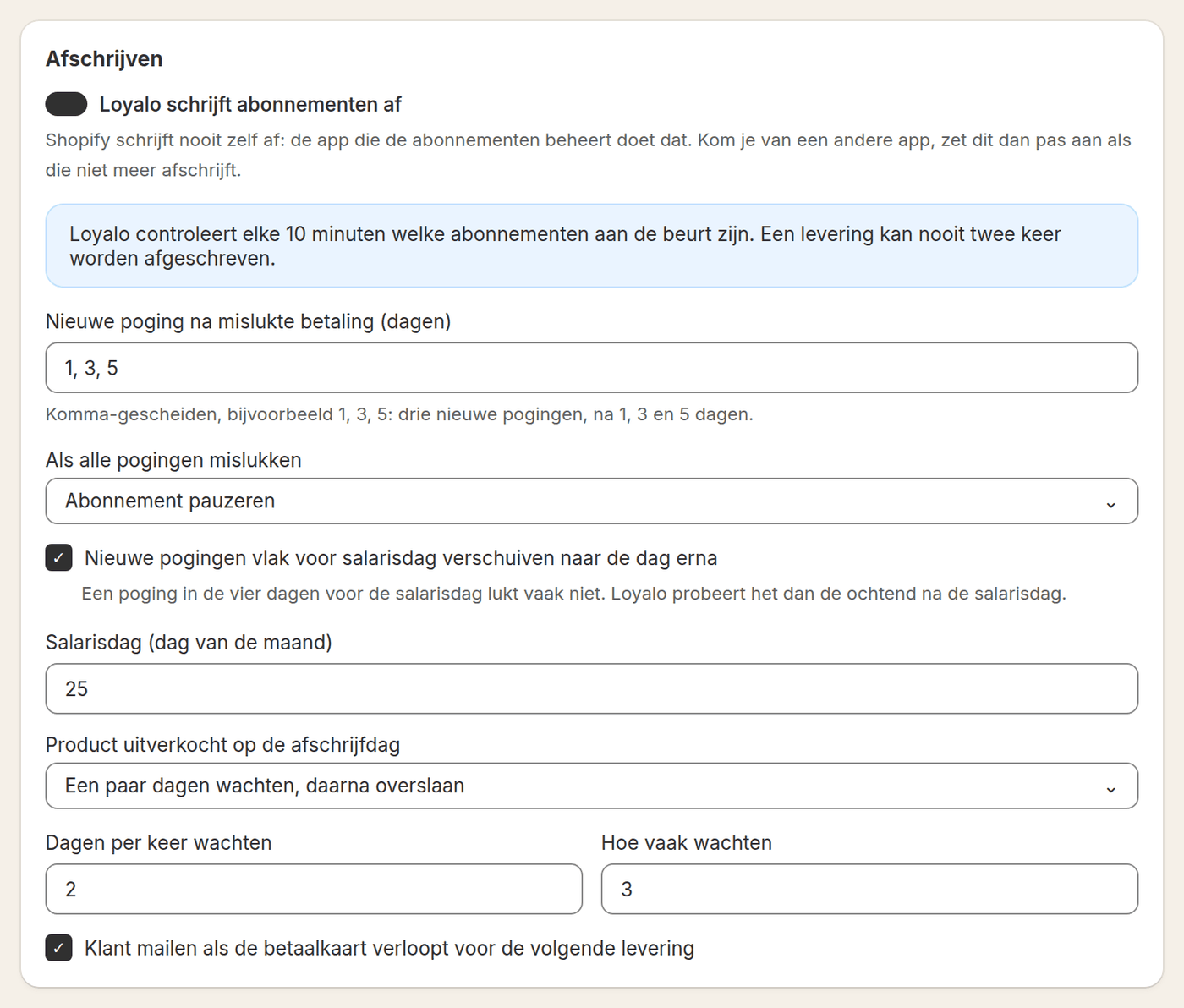
When a collection fails, Loyalo tries again, by default after 1, 3 and 5 days. The customer gets an email with every attempt. You choose what happens when all attempts fail.
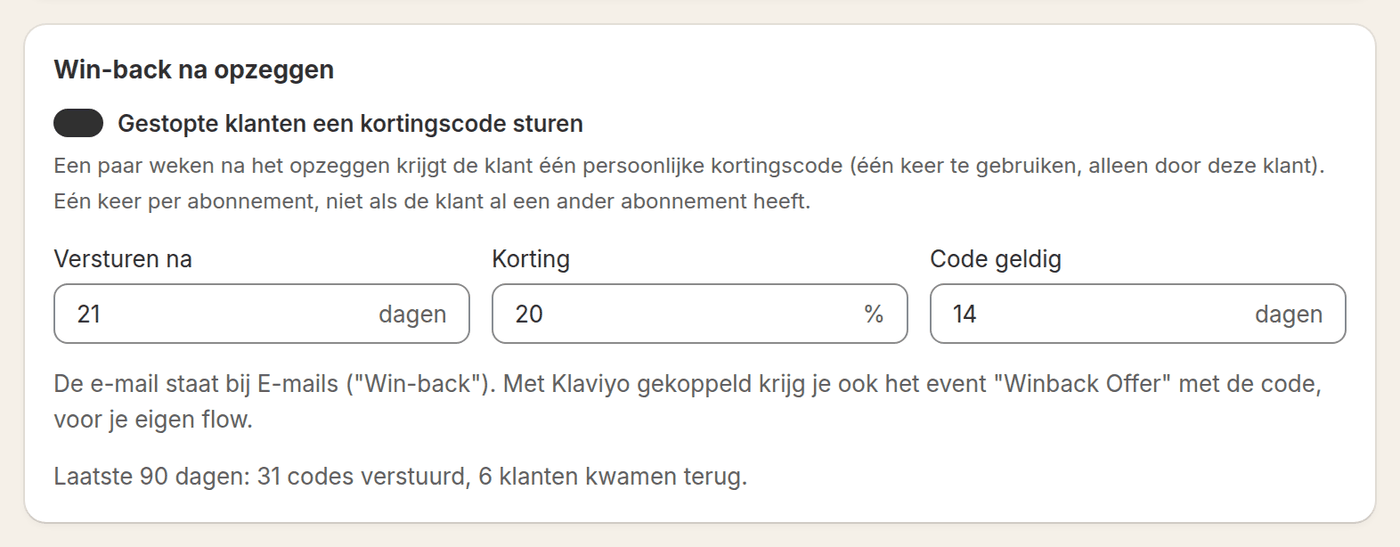
A few weeks after cancelling the customer gets a personal discount code. The code can be used once and only by that customer. It happens once per subscription, and not when the customer still has another subscription.
The best cancellation is one that is not needed. A subscription that moves with the customer is stopped less quickly.
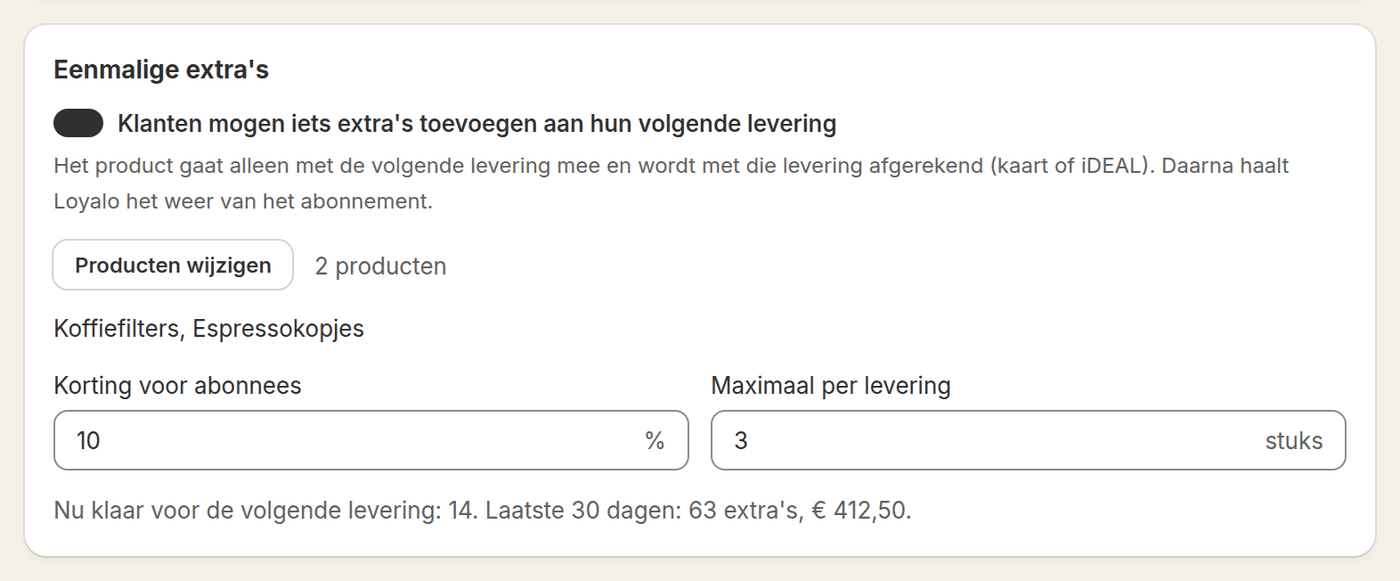
In the portal subscribers add a single product to their next delivery, with a discount only they get. It is charged with that delivery and then leaves the subscription again.
Pausing, resuming and moving the delivery date is something the customer does in the portal, without a ticket and without ordering again.
Read moreThe email about the next delivery has buttons to skip or reschedule right away. The link works once and asks for no login.
Choosing another flavour or size works within the same plan, keeping the discount. Boredom is no longer a reason to cancel.
With Customer Loyalty every delivery earns points, and a higher tier gives a discount or free shipping.
Read moreUnder Analytics you find the figures that show whether your retention works, per period of 30 days, 90 days or a year.
| Figure | What it tells you |
|---|---|
| Churn | The share of subscriptions cancelled in the period, divided by what was running at the start |
| Cancellation reasons | Which reasons customers choose most often |
| Offer accepted | The share of customers who stayed after an offer |
| Paid after all | The share of deliveries that were paid after a failed attempt |
| With a payment problem now | How many subscriptions are waiting for a new attempt right now |
| Cohorts | Which part of the subscriptions from a start month is still running after 1, 2, 3, 6 and 9 months |
A schedule only works when you see what it does. Subscriptions with a problem come to the top by themselves.
See what you can measureChurn is the share of subscribers who stop in a period. Loyalo calculates it as the number of cancelled subscriptions divided by the number of running subscriptions at the start of the period. Voluntary churn is a customer who cancels; involuntary churn is a subscription that stops because a payment fails.
Dunning is following up failed payments: trying the payment again and telling the customer something went wrong. In Loyalo you set the days of the new attempts, the customer gets an email with every attempt and you choose what happens when everything fails.
Yes. For every reason you choose a discount, skipping a delivery, pausing, delivering less often or no offer. When the customer picks no reason, the default discount you set applies.
No. You set a period in which the same subscription gets no new offer, for example ninety days.
As often as you set, up to six times. By default three times: after 1, 3 and 5 days. An attempt in the four days before payday can move to the morning after automatically.
An email with a personal discount code for a customer who stopped, a number of days after cancelling that you set. Loyalo sends it, or you build your own flow in Klaviyo on the event Loyalo sends along.
Yes. You set a minimum number of deliveries and a notice period of at most a month. When a customer cancels earlier, the subscription stops after the term or the notice period and they get a confirmation of that.
You choose: collect anyway, wait a few days and try again, or skip the delivery.
No. The cancellation flow, retries, win-back and one-time extras are in every plan.
Read on: Setting up retention and dunningBlog: reducing churnBlog: dunning for failed payments
In half an hour we show you how Loyalo works in your shop, or we send you an install link right away. The trial runs for 14 days and needs no credit card.
In a demo we walk through the cancellation flow, the retries and the figures behind them.