What is a loyalty programme?
A loyalty programme is a scheme in which a shop rewards customers for coming back: those who buy more often collect towards a reward. You know the form from the loyalty card or stamp card in a shop. A loyalty programme for ecommerce works with points on the customer account: the customer earns with every order and redeems the points for a reward.
The benefits of a loyalty programme for an online shop:
- Retention: a customer with a balance has a reason to place the next order with you again
- Larger orders: a reward with a minimum order amount, or a tier that is within reach, gives a reason to add something
- More reviews and newsletter sign-ups, if you give points for them
- New customers through existing customers, if they can refer friends
- A view of your regular customers: the balance sits on a customer account, so you see who earns, who redeems and who comes back
Points alone do not make customers loyal: the product and the service have to be right. A programme gives satisfied customers a reason to order from you more often. Below are the types of programme first, then six steps to create one yourself, from the goal to measuring.
Types of loyalty programme, with examples
Most programmes combine a few types. The table shows how each type works, with an example. The shops in the examples are made up, and so are the numbers.
| Type | How it works | Example |
|---|---|---|
| Points per euro | The customer gets points for every euro spent and redeems them for a reward | Brandpunt Koffie calls its points 'beans': 5 beans per euro, and € 5 off for 1,000 beans |
| Tiers (levels) | The customer reaches a level based on what they spend or how often they order, and gets fixed perks with it | Studio Huid has three tiers. Whoever spends € 300 in 12 months reaches Gold and gets 10% off and free shipping |
| Bonus points | Points for something other than a purchase: a customer account, a review, the newsletter, a birthday | Studio Huid gives 100 points for a review and 50 more with a photo |
| Extra points on a product or in a period | A product or a campaign week earns a multiple of the points | Trouwe Poot gives double points on all orders for a week, and three times the points on a new kind of pet food |
| Refer a friend | A customer shares a personal link or code. The friend gets a discount on the first order, the customer gets points | At Vitaal Dagelijks the friend gets 10% off the first order and the customer 500 points once the return period has passed |
| Paid membership | The customer pays a fixed amount per month or per year and gets fixed perks for it, such as free shipping | A fixed amount per year for free shipping on every order. Loyalo does not have this type |
With a Shopify loyalty app such as Loyalo you set up the first five types and combine them. A paid membership is a different form, which Loyalo does not offer. Which type fits your shop depends on what you want to achieve. That is where step 1 starts.
Step 1: choose what you want to achieve
Start with the behaviour you want to see more often. 'More loyal customers' is too broad a goal to steer on. Choose one or two goals you can measure; the goal decides what you give points for and how you will measure whether it works.
| Goal | What you reward | How you see it |
|---|---|---|
| Ordering more often | Points per euro, with a first reward that is quickly within reach | The share of customers who order more than once |
| More per order | A reward with a minimum order amount, or tiers based on amount spent | The average order value |
| More reviews | Points per review, extra with a photo | The number of reviews per month |
| New customers | Refer a friend: a discount for the friend, points for the customer | Orders through an invitation |
Step 2: points per euro and what a point costs
A points programme turns on two numbers: how many points a customer gets per euro, and how many points a reward costs. Together they decide which share of revenue you give back. An example: at 5 points per euro and a reward of € 5 for 1,000 points, a customer spends € 200 for that € 5. You then give back 2.5%.
Put that percentage next to your margin, not your revenue. And look at how quickly the first reward is within reach: with an average order of € 40, € 200 takes five orders. If that is too far away, add a smaller reward, such as free shipping for fewer points. The numbers are an example; the calculation is the same for every programme.
In Loyalo points are counted over the product amount after discount, without shipping costs. With a refund or cancellation the points are deducted proportionally. You give the points a name of your own; the demo shop in the images collects beans, for example.
Step 3: choose rewards that fit your shop
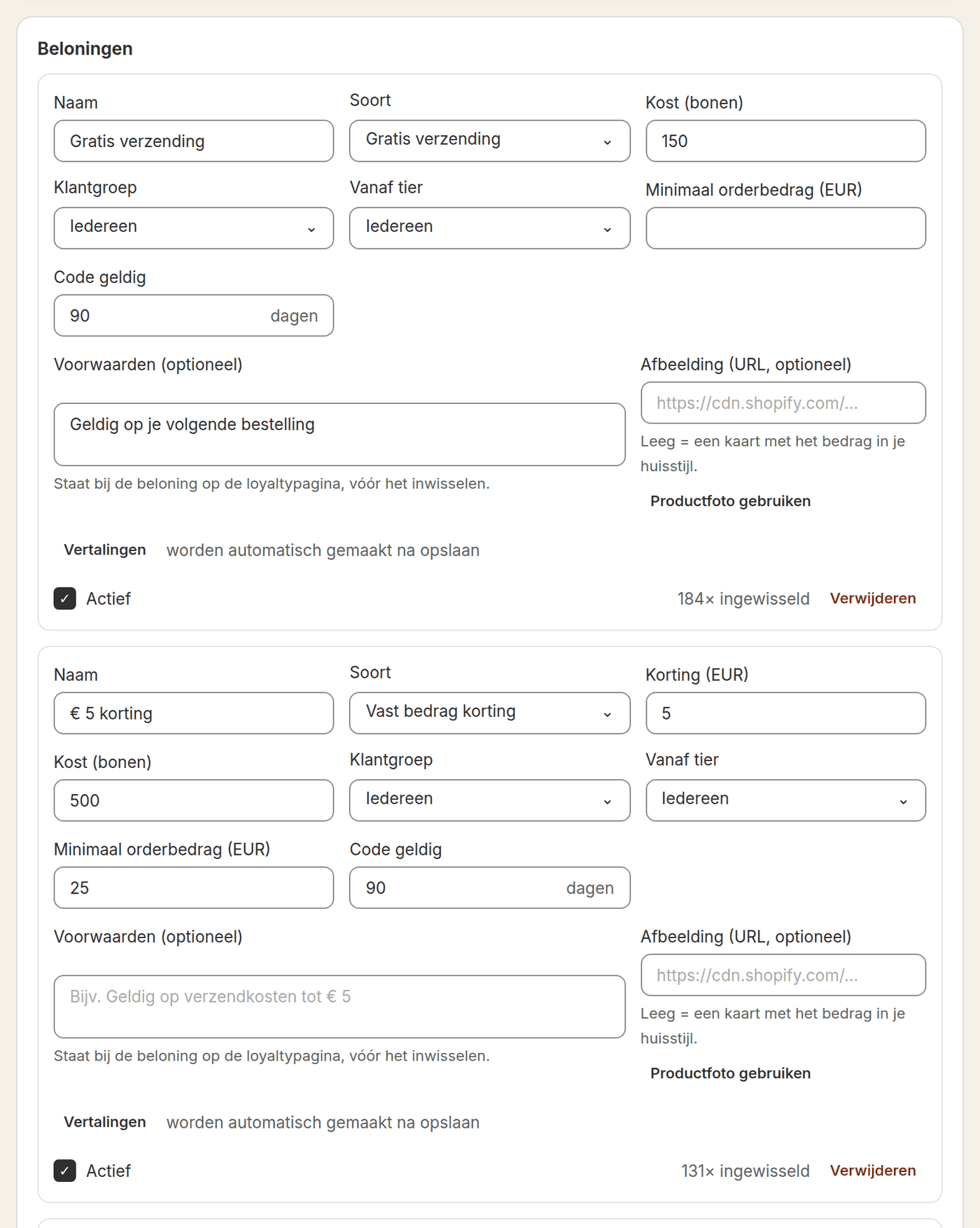
A reward has to be worth it for the customer and affordable for you. Loyalo has six kinds. Start with two or three and expand once you see what customers choose.
| Reward | When it fits |
|---|---|
| Fixed amount off | Easy to explain; combine it with a minimum order amount |
| Percentage off | With large differences in order value; the value grows with the order |
| Free shipping | A small reward that is quickly within reach |
| Free product | To let customers try something new or to use stock |
| Store credit | Credit on the customer account in Shopify, to spend at checkout |
| Donate to a charity | The customer gives points away; you pay the amount to the charity |
Step 4: tiers for your best customers
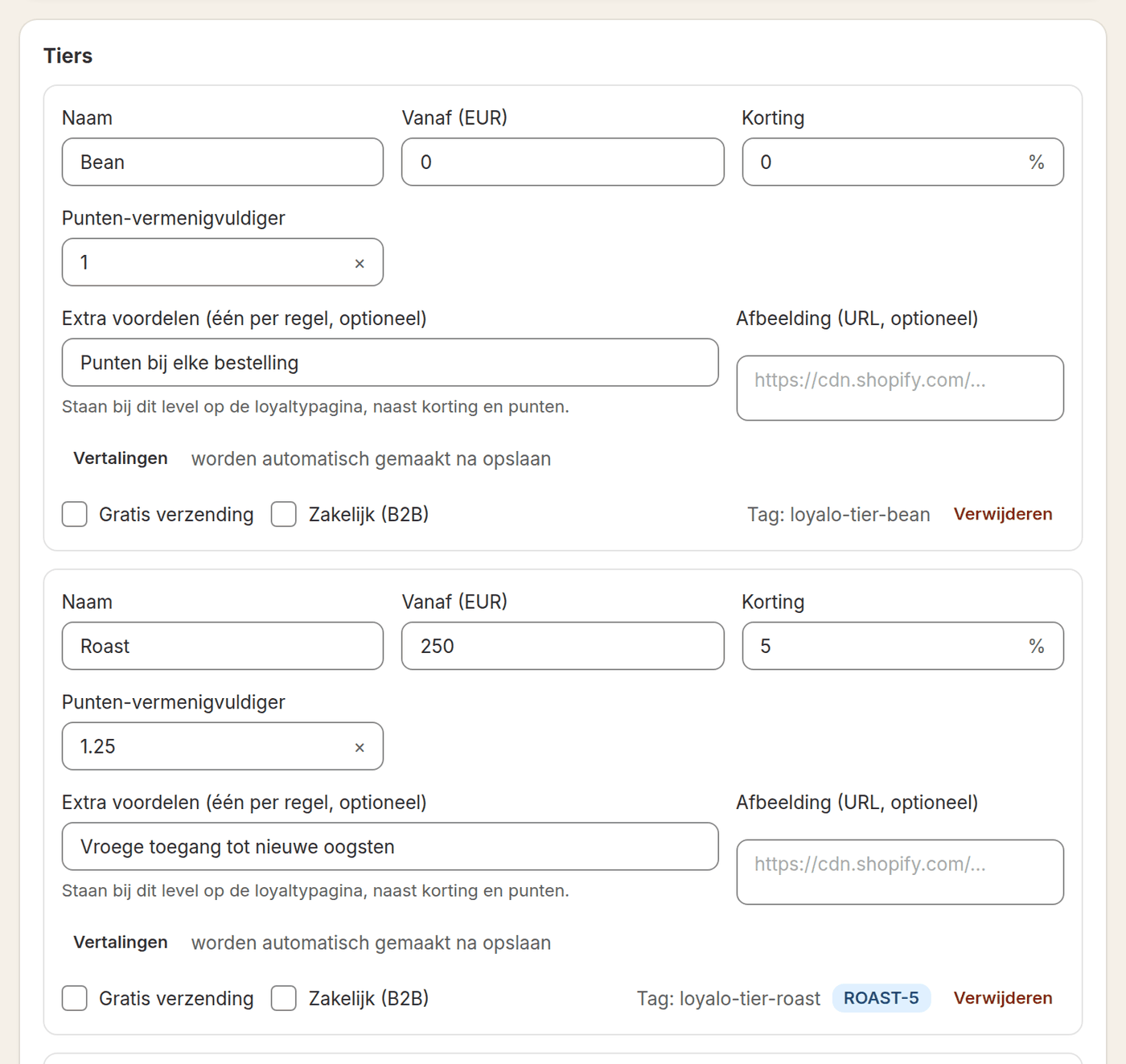
Points reward an order; tiers reward a customer. A tier is a level a customer reaches based on the amount spent, the number of orders, the points earned or the number of items. Per tier you set a discount, free shipping, a points multiplier and your own perks, such as early access to new products.
Two choices decide how tiers feel. The first is the threshold: if the first higher tier is within reach of a customer who orders a few times a year, everyone has something to work towards. The second is the period. If everything a customer has ever spent counts, a tier lasts forever. If only the last 12 or 24 months count, a customer has to keep earning the tier; with a grace period in days they first get an e-mail that the tier is ending.
Step 5: more ways to earn
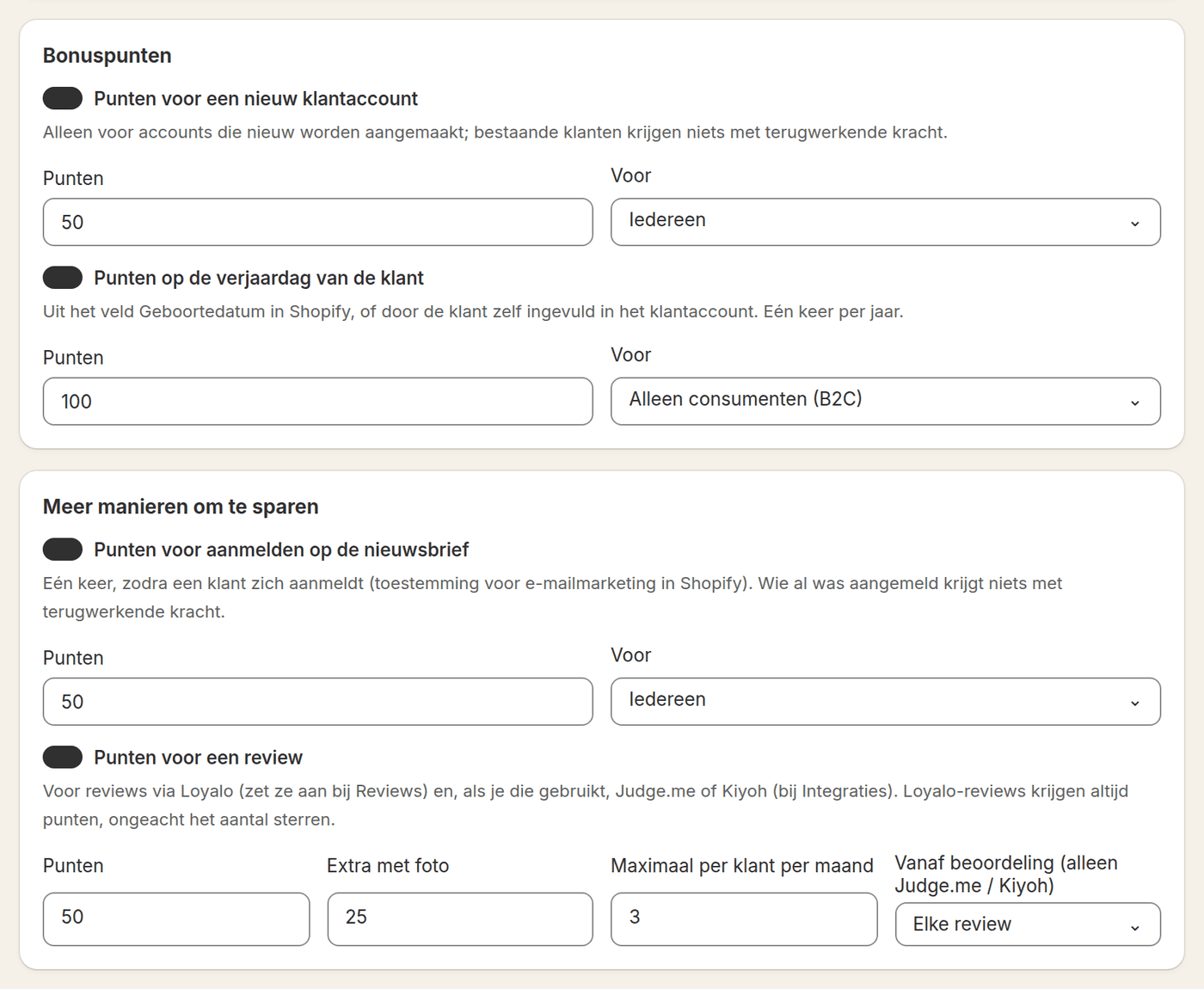
Points per euro reward spending. With bonus points you reward the rest of the behaviour you chose in step 1:
- A new customer account: the first points are there straight away
- The customer's birthday, once a year
- Signing up for the newsletter
- A review, with extra points for a photo and a maximum per customer per month
- Following on social media, once per channel
- A campaign period in which all orders earn two or three times the points
- Extra points on a product you want to put in the spotlight
- Refer a friend: the friend gets a discount on the first order, the customer gets points
For referrals you set a waiting period, for example the return period. The customer only gets the points after that; with a cancellation or full refund they lapse. The discount for the friend only works for customers without an earlier order.
Step 6: show the programme
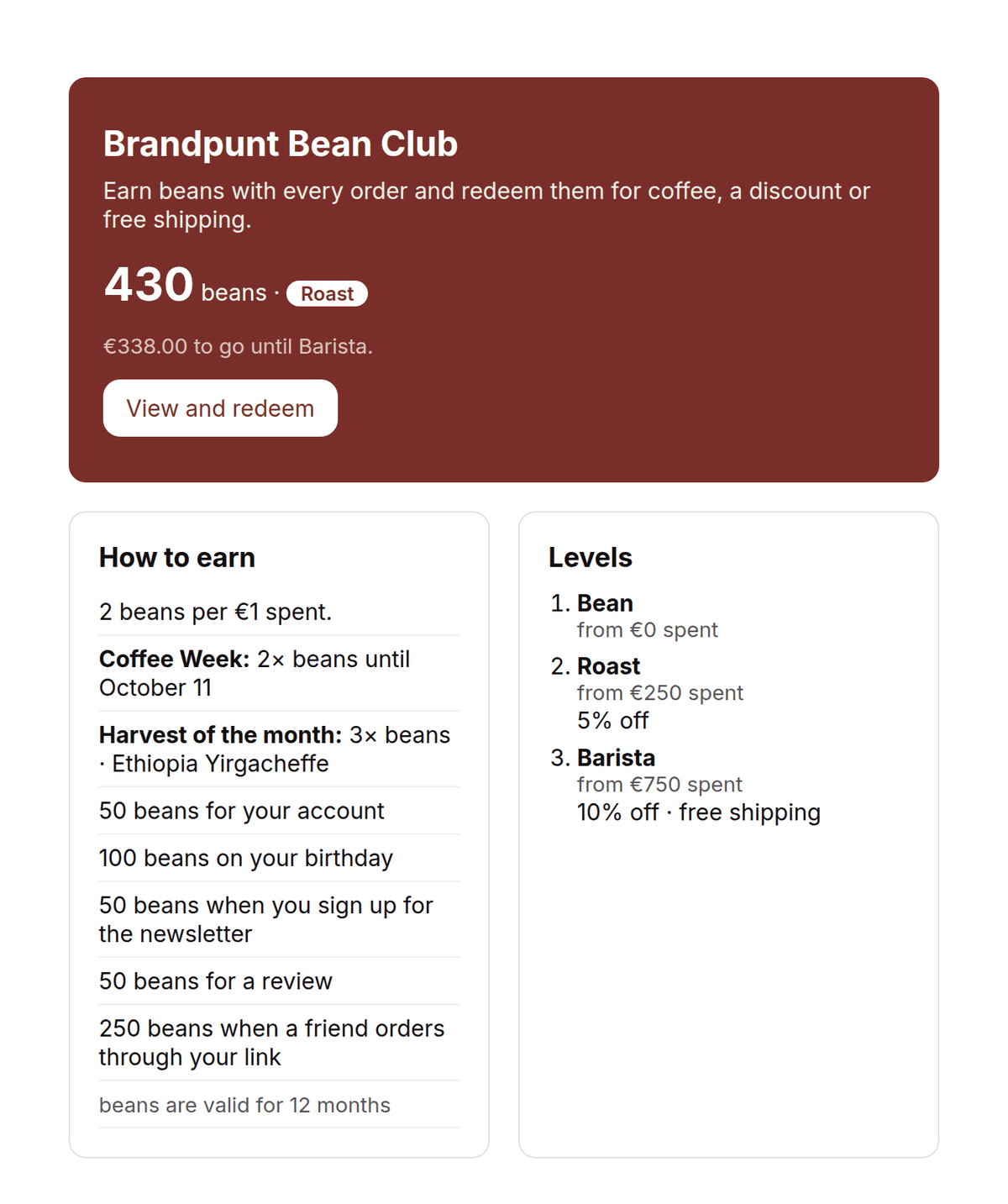
A programme customers do not see changes no behaviour. Put it where a customer already goes: a rewards page in your shop, the balance in the customer account and a monthly points summary by e-mail. Two e-mails also do a lot of the work: a message as soon as a customer has enough points for a reward, and a message before points expire.
What does a loyalty programme cost, and what does it bring in?
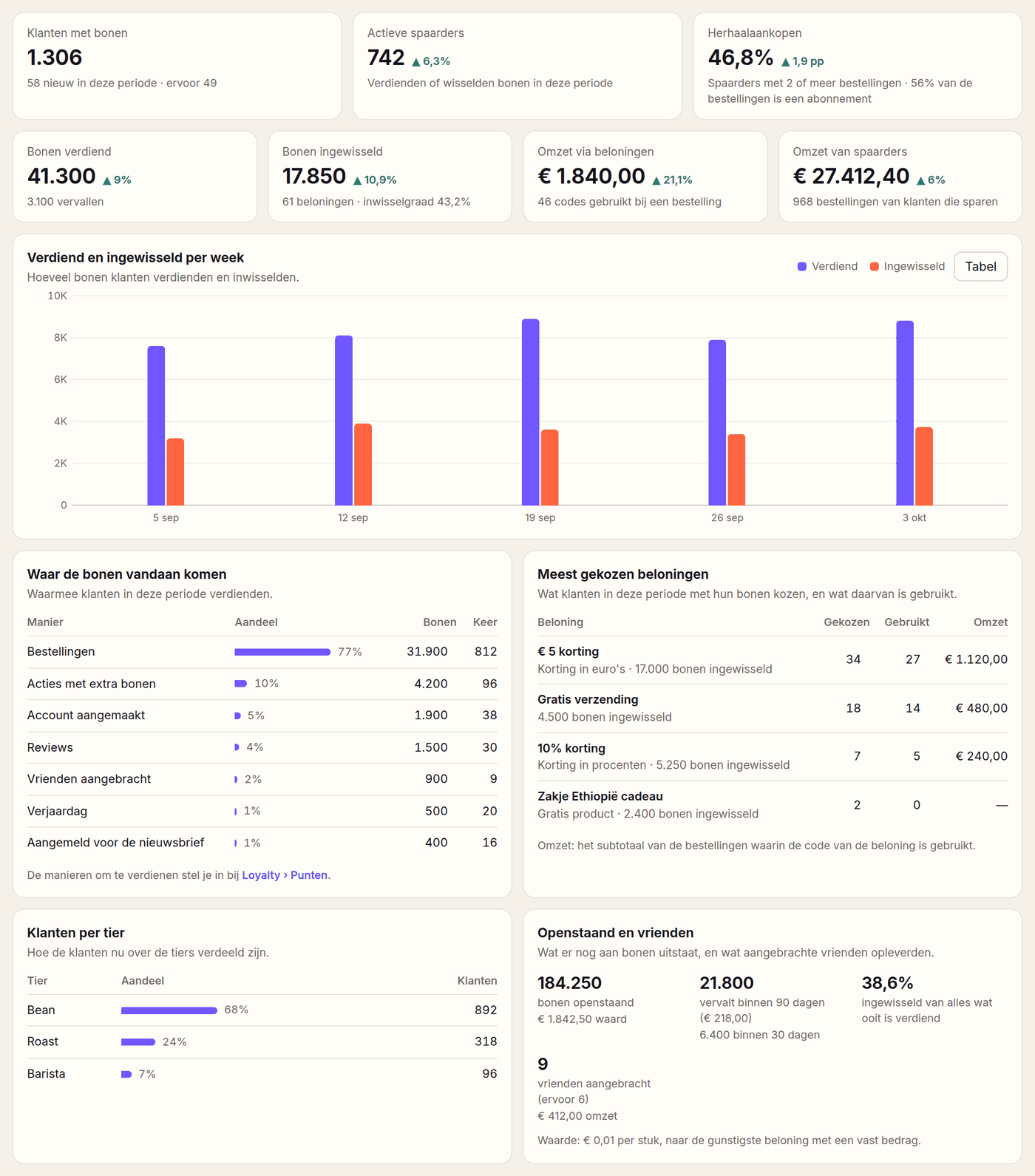
The cost of a loyalty programme has two parts: the software, and the rewards customers redeem. The second part grows with your revenue, and you set it yourself with the numbers from step 2. Points that are still outstanding are a liability: customers can still redeem them later. So keep track of three figures: how many points are outstanding, how many are redeemed per month and how much revenue comes from orders on which a reward was used.
On the return side, look at the share of repeat purchases and the average order value, and compare with the months before the start. Do not compare members with non-members: customers who already ordered often are also more likely to collect points, so part of that difference was already there.
A loyalty programme for B2B customers
You can reward loyalty in B2B with a programme too. A B2B loyalty programme uses the same building blocks, but the rules for consumers do not always fit: business customers usually order larger quantities and often have their own prices already. The same number of points per euro gives a lot back on orders like that.
So in Loyalo you treat the two groups separately. For business customers you set their own number of points per euro, or you switch earning off for them. They get their own series of tiers, on a different basis if you want: consumers on amount spent, for example, and business customers on the number of items. Bonus points, campaigns and rewards can each apply to everyone, consumers only or business customers only. Who counts as a business customer follows from the companies in Shopify B2B or from a tag on the customer; you can also choose the group by hand.
Common mistakes
- The first reward is too far away, so customers drop out before they redeem anything
- The value of a point is calculated on revenue instead of margin
- Points expire without the customer getting a message beforehand
- There are too many rules at once: start with points per euro and two rewards
- The programme is only in the footer and nowhere in the e-mails
- Choose one or two goals and give points for those
- Work out which percentage of revenue you give back and put it next to your margin
- Make the first reward reachable within a few orders
- Decide whether points expire and e-mail customers beforehand
- Measure repeat purchases and order value before and after the start
Frequently asked questions
How does a loyalty programme work?
A customer gets points for every euro spent, and sometimes for something else, such as a review or a birthday. The balance sits on their customer account. Once they have enough points, they redeem them for a reward, such as a discount, free shipping or a free product.
How do you set up a loyalty programme?
In six steps: choose a goal, set the points per euro and work out what a point costs, choose rewards, add tiers for your best customers, give bonus points for other behaviour and show the programme in your shop and your e-mails. Start small, with points per euro and two rewards.
What does a loyalty programme cost?
The cost has two parts: the software and the value of the rewards customers redeem. You set the second part yourself with the points per euro and the price of a reward in points. At Loyalo, Customer Loyalty costs € 199 per month or € 1,990 per year, on top of a plan; the smallest plan is Growth at € 99 per month. There is no fee per order and no price per member.
What is the difference between a loyalty card and a loyalty programme?
A loyalty card is one form of a loyalty programme: a card you collect with in the shop. Online the balance sits on the customer account and the customer does not need a card. The principle is the same: collect with every purchase and redeem for a reward.
Does it also work in a physical shop?
Yes, if you use Shopify POS. At the till your staff see the customer's points and tier and put a reward on the receipt. Purchases in the shop earn points as well.
Should points expire?
That is a choice. Expiry limits the number of outstanding points and gives a reason to come back. In Loyalo you choose after how many months points expire, or that they never expire. The oldest points are used first and the customer gets an e-mail beforehand.
Can I treat business customers separately?
Yes. For business customers you set their own number of points per euro, or you switch earning off for them. Bonus points, campaigns and rewards can each apply to everyone, consumers only or business customers only.
Do subscribers earn points too?
Yes, if you switch that on. A paid subscription delivery then earns the same number of points per euro as a one-off order, and a subscriber can have a reward applied to their next delivery.
A loyalty programme for your shop
In a demo we show how points, rewards and tiers work in Loyalo and what it looks like for your customer.
Request a demo