What is SEPA Direct Debit?
SEPA Direct Debit is a payment method in which you, with the customer's permission, collect amounts from their bank account yourself. That permission is called a mandate. You start the payment, not the customer. It works in euros and across the whole SEPA area.
A subscription or repeat order needs a payment method you can use without the customer being there every time. In the Netherlands that is usually SEPA Direct Debit, often started with a payment through iDEAL. Below you find how a mandate works, which periods you need to know and what you need to arrange as a webshop.
There are two schemes. The regular scheme (Core) is meant for consumers and gives the customer the right to have a debit refunded. The business scheme (B2B) is for companies only: the customer's bank checks the mandate beforehand and an authorised debit cannot be refunded. Webshops almost always use the regular scheme, and that is what the rest of this article is about.
What is a SEPA mandate?
A SEPA mandate is the permission the customer gives you to collect amounts from their account. The mandate is the agreement; the direct debit is the collection you make on the strength of it. Without a valid mandate a debit is unauthorised, and the customer can then claim the money back up to thirteen months after the debit.
As a rule a mandate records:
- Who may collect: the name of the creditor
- From which account: the name and account number (IBAN) of the customer
- Whether the mandate is one-off or recurring
- A unique reference for the mandate
- The date on which the customer gave the mandate
The customer gives the mandate once. After that the following debits fall under it, without the customer having to do anything again. If you collect through a payment provider, it records the mandate for you.
One-off or recurring mandate
A one-off mandate covers a single debit. A recurring mandate covers all debits until the customer withdraws it. For a subscription you need a recurring mandate: you do not know beforehand how many deliveries will follow.
The scheme and the kind of mandate show up in the name many Dutch banks print next to the debit on the bank statement. 'SEPA Incasso Algemeen Doorlopend' (general, recurring) is a debit under the regular scheme (Core) on a recurring mandate. That is the form a webshop uses for a subscription, and the customer can have such a debit refunded within eight weeks. 'SEPA Incasso Bedrijven' (businesses) is the business scheme (B2B): for companies only, and an authorised debit cannot be refunded there.
How you get a mandate online
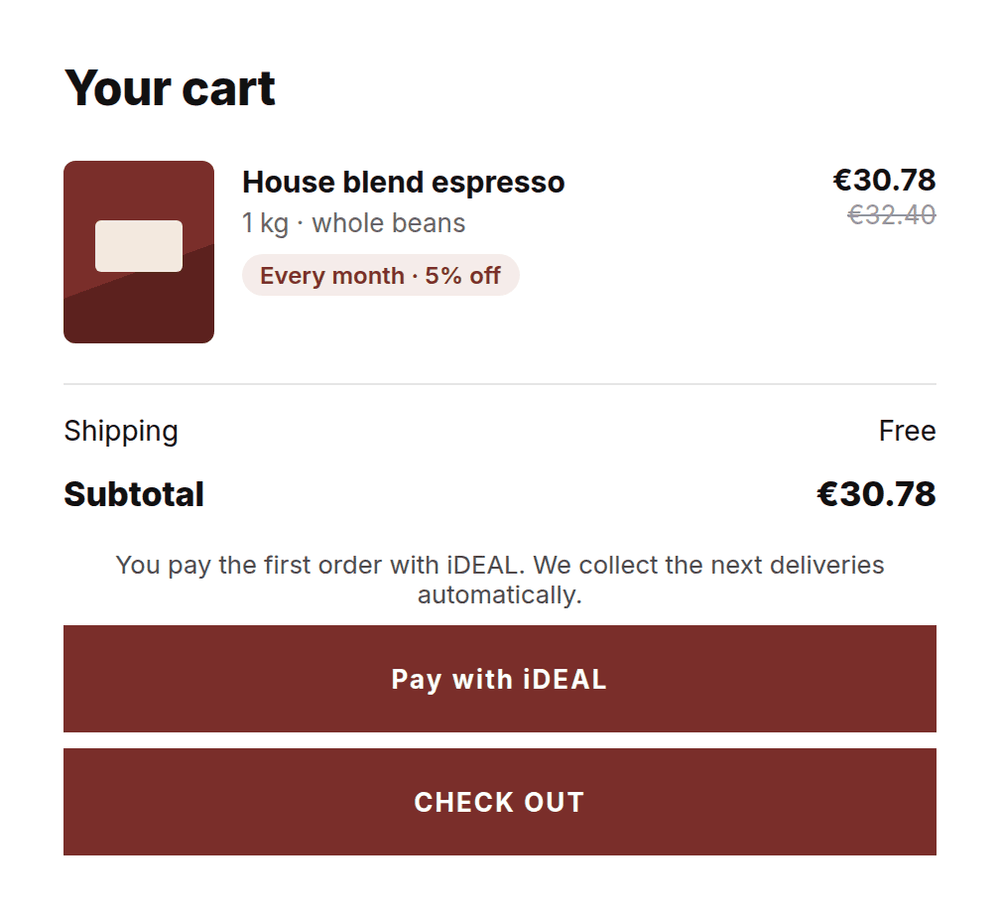
On paper a mandate is a form with a signature. Online the usual route is a first payment. The customer pays the first order with iDEAL, and from that payment the payment provider, for example Mollie, records the mandate on the account number that was used to pay. For the customer it feels like an ordinary iDEAL payment; for you it is the start of the direct debits.
- First paymentThe customer pays the first order with iDEAL and agrees to the following debits.
- Mandate recordedThe payment provider links a recurring mandate to the account number of that payment.
- NotificationBefore every following debit you let the customer know which amount will be collected when.
- Debit submittedOn the agreed date you submit the debit. Processing takes a few business days.
- Paid or failedIf the debit succeeds, the delivery is paid. If it does not, a new attempt or a payment request to the customer follows.
Periods you need to know
| Period | What it means | Consequence for your webshop |
|---|---|---|
| Notification: at the latest 14 days beforehand, unless you agreed a shorter period with the customer | The customer knows beforehand which amount will be collected when | Put a shorter period in your terms and send a reminder before every delivery |
| Processing: a few business days | A debit is not confirmed straight away, unlike an iDEAL payment | The payment is open first; payout by your payment provider can take longer |
| Refund without giving a reason: 8 weeks | The customer can have the debit reversed through their bank | A paid delivery can still become unpaid |
| Unauthorised debit: 13 months | Without a valid mandate the customer can claim the money back up to 13 months after the debit | Keep a record of when and how the mandate was given |
| Mandate lapses: 36 months without a debit | A mandate that has not been used for three years is no longer valid | A customer who paused for a long time has to give a new mandate |
These periods come from the rules for SEPA Direct Debit and apply to the regular scheme. Your payment provider may apply its own limits, such as a maximum amount per debit. Have the wording of your mandate and your terms checked by someone who knows the subject; this article is not legal advice.
Why a debit fails
- There is too little balance in the account at the moment of collection
- The account has been closed or blocked
- The customer has withdrawn the mandate or blocked the debit at their bank
- The customer has the debit reversed afterwards
The first cause is usually temporary: a few days later there is enough balance. That is why a schedule of new attempts works, preferably shortly after the day salaries come in. With the other causes trying again is pointless and the customer has to do something: pay through a link or give a new mandate.
Direct debit, card or iDEAL
| Payment method | Recurring? | Strong point | Mind this |
|---|---|---|---|
| iDEAL | No, one-off | Familiar and confirmed straight away | Only suitable for the first payment |
| SEPA Direct Debit | Yes | Keeps running without an expiry date, as long as the mandate is used | Processing takes days; a reversal is possible for up to 8 weeks |
| Credit card or Shop Pay | Yes | The result is there straight away | A card expires, and not every customer has one |
The combination that makes most sense in the Netherlands is iDEAL for the first payment and SEPA Direct Debit for the rest. Offer a card next to it for customers who prefer that.
What you need to arrange as a webshop
- A payment provider with SEPA Direct Debit activated on your account
- Clear wording at checkout: the customer agrees to the following debits
- The notification period in your terms, and a reminder before every delivery
- A recognisable description on the bank statement, so the customer can place the debit
- A schedule for failed payments, with an e-mail in which the customer can pay directly
- A way for the customer to switch accounts
- Cancelling and pausing without a detour: a customer who cannot cancel will reverse the debit
SEPA Direct Debit through Mollie: how it runs in Loyalo
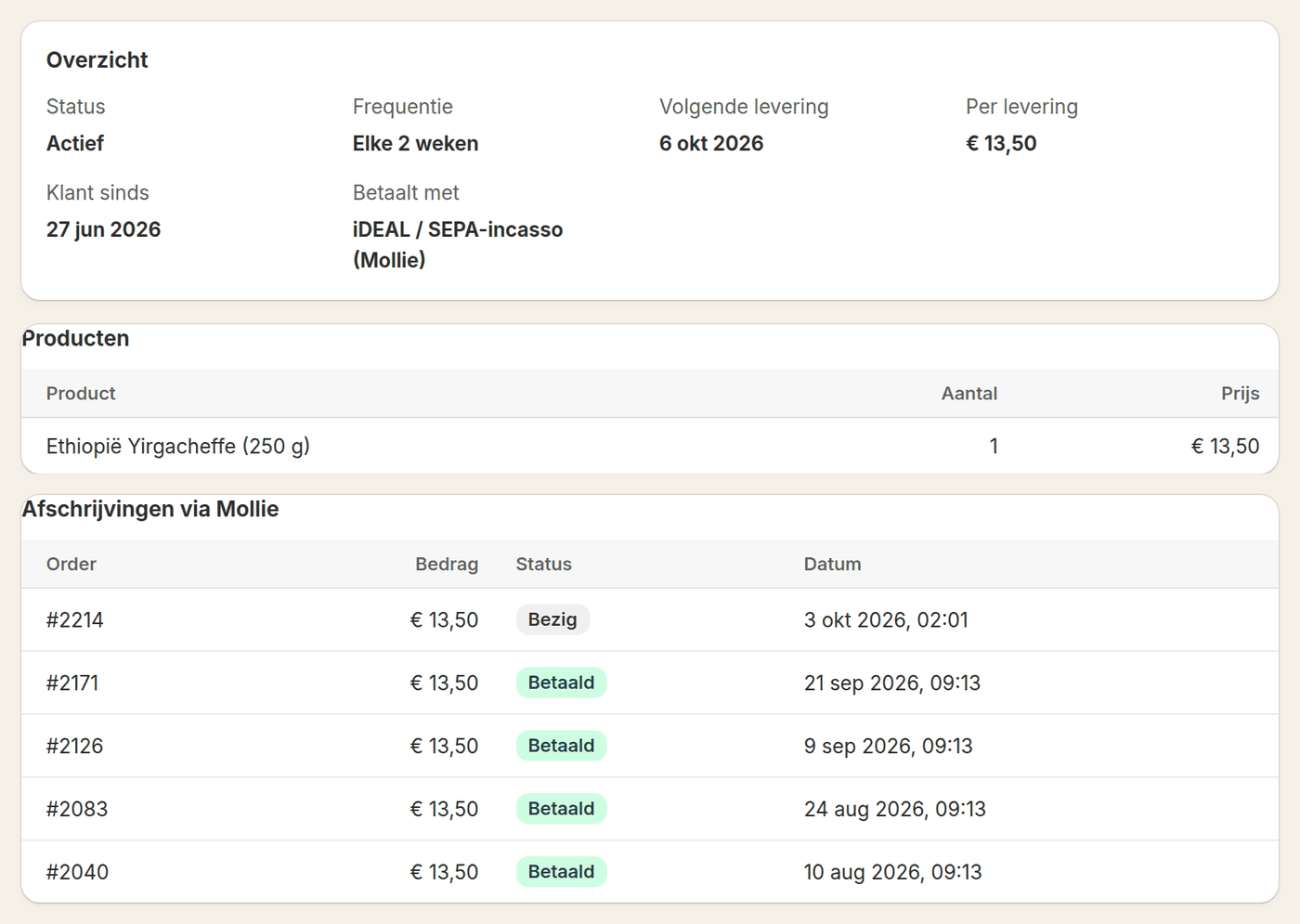
Loyalo uses your own Mollie account. The customer pays the first order with iDEAL and Loyalo records the mandate from it. For every delivery Loyalo creates the order in Shopify and submits the debit to Mollie; as soon as the debit has succeeded, the order is marked as paid. The customer's bank statement shows your shop name and the order number. The money goes straight to your Mollie account. Subscriptions with a credit card run through Shopify.
If a debit fails, the schedule of new attempts follows, by default after 1, 3 and 5 days. With every attempt the customer gets an e-mail with a payment link; if they pay with it, the mandate is renewed straight away. If a customer has a paid debit reversed, the order in Shopify gets the tag loyalo-stornering and Loyalo collects the amount again through that same schedule. The customer switches accounts in the portal, with a payment of € 0.01 through iDEAL.
Frequently asked questions
What is the difference between a SEPA mandate and a SEPA Direct Debit?
The mandate is the customer's permission; the direct debit is the collection you make on the strength of it. The customer gives a recurring mandate once, and after that all following debits fall under it until they withdraw it.
What does 'SEPA Incasso Algemeen Doorlopend' on my bank statement mean?
It is what many Dutch banks print when a company has collected an amount from your account on a recurring mandate, under the regular scheme for consumers. You can have such a debit refunded through your bank within eight weeks. If it says 'SEPA Incasso Bedrijven', it is the business scheme, where an authorised debit cannot be refunded.
Is a Dutch 'automatische incasso' the same as SEPA Direct Debit?
Yes. Direct debits in the Netherlands run through the European SEPA system. The name differs, the rules are the same.
How long can a customer have a debit reversed?
Up to eight weeks after the debit, without giving a reason. If there was no valid mandate, it is possible up to thirteen months after the debit.
Do I need a direct debit contract with my bank?
Not if you collect through a payment provider such as Mollie; it submits the debits for you. If you want to collect directly through your own bank, you do need a contract for that.
Is there a maximum amount?
That depends on your payment provider. At Mollie the default limit for a SEPA Direct Debit is € 1,000 per payment. Check the current limit in your own account.
Does SEPA Direct Debit also work outside the Netherlands?
Yes, in all countries of the SEPA area and in euros. What differs per country is the first payment that records the mandate: in the Netherlands that is iDEAL, which is what Loyalo uses.
What happens to a mandate when a customer pauses for a long time?
A mandate that has not been used for 36 months lapses. If the subscription starts again after that, the customer gives a new mandate with a small payment through iDEAL.
See how direct debit through Mollie runs in Loyalo
In a demo we show the first payment, the mandate and how a failed debit is handled.
Request a demo