How to measure customer satisfaction
You measure customer satisfaction by asking customers one short question at a fixed moment and turning the answers into a number. The three common measures are NPS (net promoter score), CSAT (customer satisfaction score) and CES (customer effort score). Each asks a different question, so each measures something different.
NPS asks whether a customer would recommend your shop and says something about the relationship as a whole. CSAT asks how satisfied someone is with one thing, such as a delivery or a conversation with your customer service. CES asks how much effort something took, such as a return or changing a subscription.
A number on its own is worth little. Measuring satisfaction only becomes useful when you ask the same question at the same moment every time, compare the result per period and per group of customers, and act on what customers write next to their score.
What is NPS?
NPS stands for net promoter score. You ask one question: how likely is it that you would recommend this shop to a friend or colleague? The customer answers on a scale from 0 (not at all likely) to 10 (extremely likely). Net Promoter, NPS and Net Promoter Score are registered trademarks of Bain & Company, Satmetrix and Fred Reichheld.
You sort the answers into three groups:
| Score | Group | Meaning |
|---|---|---|
| 9 or 10 | Promoters | Customers who are likely to recommend your shop |
| 7 or 8 | Passives | Satisfied but not outspoken; not part of the subtraction |
| 0 to 6 | Detractors | Customers who are unhappy or in doubt |
How to calculate NPS
NPS = the percentage of promoters − the percentage of detractors. Passives count towards the total number of answers, but not in the subtraction. The result is a number between −100 (everyone is a detractor) and +100 (everyone is a promoter). It is not a percentage: you write 40, not 40%.
A worked example. Studio Huid, a fictional skincare shop, sends the NPS question a few days after every delivery for one month. It gets 200 answers: 110 customers give a 9 or 10, 60 give a 7 or 8 and 30 give a 6 or lower. Promoters are 110 ÷ 200 = 55%, detractors 30 ÷ 200 = 15%. The NPS is 55 − 15 = 40.
Split the same answers by group of customers and you see more. Of the 200 answers, 100 come from subscribers and 100 from customers who ordered once:
| Group | Promoters | Passives | Detractors | NPS |
|---|---|---|---|---|
| Subscribers (100 answers) | 60 | 30 | 10 | 60 − 10 = 50 |
| One-time buyers (100 answers) | 50 | 30 | 20 | 50 − 20 = 30 |
| Total (200 answers) | 110 | 60 | 30 | 55 − 15 = 40 |
The total of 40 hides that one-time buyers are clearly less enthusiastic. That leads to the question that helps you on: what went differently with their first order?
What is a good NPS score?
There is no number that holds for every online shop. Published comparison figures differ per industry and per way of measuring: who asks the question, at which moment, through which channel and to which customers. An NPS measured right after a delivery is a different number from an NPS taken from a yearly survey of your whole customer base. A figure from another shop therefore says little as long as you do not know how it was measured.
The comparison that does work is the one with yourself. Measure the same way and compare your score with the period before. Look per group: subscribers against one-time buyers, new customers against regulars, per product range. A score that falls, or a group that lags behind, tells you more than an absolute number. A positive NPS does not automatically mean all is well either: always read what detractors write.
CSAT score
CSAT stands for customer satisfaction score. The question is about one moment: how satisfied are you with your delivery, or with your contact with our customer service? Usually the customer answers on a scale from 1 (very dissatisfied) to 5 (very satisfied).
CSAT = the number of answers with a 4 or 5 ÷ the total number of answers × 100%. A worked example: Brandpunt Koffie, a fictional coffee shop, asks about satisfaction after every closed customer conversation. In one month it gets 80 answers: 4 times a 1, 6 times a 2, 10 times a 3, 25 times a 4 and 35 times a 5. The CSAT is (25 + 35) ÷ 80 = 75%.
Because CSAT is about one moment, you can measure it in several places and track those places separately: after the delivery, after a customer conversation, after a return. Do not add them together, or you no longer know where a drop comes from.
Customer effort score (CES)
The customer effort score measures how much effort a customer had to make. The question is, for example: how easy was it to change your subscription? The scale usually runs from 1 to 5 or from 1 to 7. The calculation differs per source: some shops take the average, others the share of customers who answer 'easy'. Pick one and stick with it.
A worked example at Brandpunt Koffie, on a scale from 1 (very difficult) to 5 (very easy): 40 customers who changed their subscription answer 2 times a 1, 2 times a 2, 6 times a 3, 14 times a 4 and 16 times a 5. The average is 160 ÷ 40 = 4.0. The share that gave a 4 or 5 is 30 ÷ 40 = 75%. CES is most useful for tasks customers do themselves, such as pausing, moving a delivery or registering a return.
CSAT vs NPS vs CES
| NPS | CSAT | CES | |
|---|---|---|---|
| The question | Would you recommend us? | How satisfied are you with this moment? | How easy was this? |
| Scale | 0 to 10 | Usually 1 to 5 | Usually 1 to 5 or 1 to 7 |
| Calculation | % promoters − % detractors | Number of 4s and 5s ÷ total × 100% | Average, or the share that answers 'easy' |
| Says something about | The relationship with your shop | One delivery or conversation | One task the customer did themselves |
| Good moment | A few days after the delivery | Right after the moment itself | Right after the task |
You do not have to measure all three. For a small online shop, one NPS question after the delivery, with an open question behind it, is often enough to start with. Add CSAT if you want to track customer service, and CES if you want to improve a process customers go through on their own.
When to ask
- After the delivery, not after the order: only once the parcel has arrived does the customer know how the product and the shipping went. A few days later gives them time to try the product.
- After a customer conversation: a CSAT question right after the conversation is closed, while it is still fresh.
- When a subscription is cancelled: ask for the reason here, not a score. Someone who cancels wants to leave; a short list of reasons gives you more than a number.
- After a task the customer does themselves: a CES question after pausing, moving or changing a subscription or after registering a return.
Do not ask the same customer too often. A subscriber who gets a delivery every month does not need the same question every month. Set a quiet period, and for subscribers measure for example after the first delivery and then at a fixed later point.
How many answers do you need?
There is no fixed number above which a score becomes reliable, but you can work out yourself how sensitive it is. With NPS, one customer moving from detractor to promoter shifts the score by 200 ÷ the number of answers. With 20 answers that is 10 points, with 200 answers 1 point. So with 20 answers, one customer having a bad day can pull your score down considerably.
If you have few answers, look over a longer period, such as a quarter instead of a month, and do not draw a conclusion from one outlier. The same goes per group: split 200 answers into five groups and each group has 40 on average, which makes each group more sensitive than the total.
Not everyone fills in a survey. Customers who are very happy or very annoyed often answer sooner than customers who have no strong view. So also track the number of answers against the number of questions sent. If that changes a lot, your score can change without your customers thinking differently.
What to do with the answers
The number tells you something is there; the explanation tells you what. So always put an open question after the score: what is the main reason for your score? Then:
- Contact detractorsRespond personally to a low score, within a few days. Ask what went wrong and fix it where you can: a new delivery, a refund, an explanation.
- Group the explanationsPut the answers to the open question into a few fixed themes, such as delivery time, packaging, product, price and customer service. Count how often each theme comes up.
- Tackle the biggest themePick the theme that comes up most among detractors and change one thing. Then measure the same way and compare with the period before.
- Ask promoters for a reviewA customer who gives a 9 or 10 is an obvious candidate to ask for a review or to refer a friend.
Signals your shop already has
A customer satisfaction survey is not the only source. Your shop already keeps figures that show what customers do, and behaviour is sometimes more honest than a survey:
- Reviews and their stars: the spread of the stars and the reviews with three stars or fewer say more than the average.
- Repeat purchases: the share of your customers who ordered more than once in a period. If it falls, customers come back less often.
- Churn and cancellation reasons: for subscriptions, the share that stops and the reason customers gave.
- Returns and the reason for the return: a rise for one product often points to the product page or the product itself.
- Questions to your customer service: the same question coming back again and again marks a point customers struggle with.
Put these figures next to your NPS or CSAT. If your score falls while returns of one product rise, you know where to look.
What Loyalo does and does not measure
Loyalo does not send an NPS or CSAT survey. For that you use a separate survey tool or your own email. Loyalo does help with the signals that have to do with subscriptions.
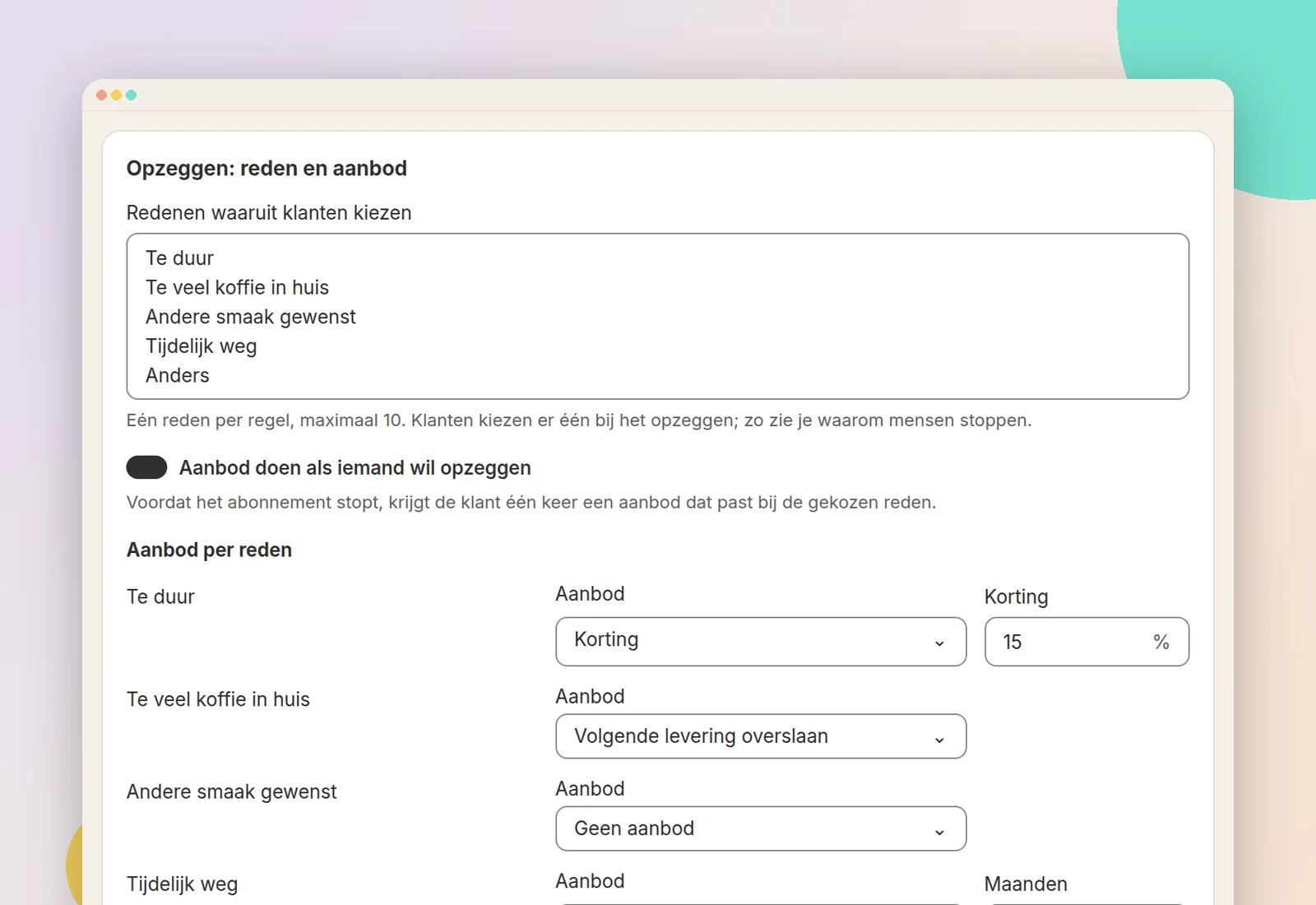
Under Subscriptions > Settings you set up to ten reasons a customer chooses from when cancelling, with an offer to stay per reason: a discount on the next deliveries, skipping a delivery, pausing for a number of months, delivering less often or no offer. If the customer cancels after all, the reason is stored. On the Analytics page you see churn, cohorts, the reasons given and how often the offer prevented a cancellation. The Loyalty tab of Analytics shows repeat purchases, among other things.
Product reviews, with invitations after an order and stars on the product page, is not for sale yet. In the app the section is marked 'Coming soon'.
Frequently asked questions
What does NPS mean?
NPS stands for net promoter score. It is a measure of customer loyalty based on one question: how likely is it that you would recommend this shop, on a scale from 0 to 10.
How do you calculate NPS?
Count the promoters (9 and 10) and detractors (0 to 6) and turn them into a percentage of all answers. NPS = % promoters − % detractors. With 55% promoters and 15% detractors, the NPS is 40.
What is a good NPS score?
There is no fixed number. Published figures differ per industry and per way of measuring. Compare your score with your own previous period and per group of customers, such as subscribers against one-time buyers.
Can NPS be negative?
Yes. If you have more detractors than promoters, the NPS is negative. The score runs from −100 to +100.
What is the difference between CSAT and NPS?
CSAT measures satisfaction with one moment, such as a delivery or a customer conversation, usually on a scale from 1 to 5. NPS measures whether a customer would recommend your shop and says more about the relationship as a whole.
How do you calculate a CSAT score?
Divide the number of answers with a 4 or 5 by the total number of answers and multiply by 100%. With 60 answers of 4 or 5 out of 80, the CSAT is 75%.
What is the customer effort score?
CES measures how much effort a customer had to make for a task, such as a return or changing a subscription. You calculate the average or the share of customers who answered 'easy'.
Which KPI should I use for customer satisfaction?
Pick one fixed score, such as NPS after the delivery, and track it per month or quarter. Put behavioural figures you already have next to it: repeat purchases, churn, cancellation reasons and returns.
Can I run an NPS survey in Loyalo?
No, Loyalo does not send an NPS or CSAT survey. In Loyalo you do see why subscribers cancel, how often an offer at cancellation worked and churn per period and per cohort.
See why your subscribers stop
In a demo we show where cancellation reasons, the offer when cancelling and churn are in Loyalo and how to read them.
Request a demo