What is average order value?
Average order value is your revenue in a period divided by the number of orders in that period. The figure tells you what a customer spends per order on average. It is usually shortened to AOV.
The figure matters because many costs are fixed per order. Shipping, packaging, payment fees and what you spent to acquire the customer are almost the same for an order of € 30 as for one of € 60. So a larger order leaves more margin than the same amount in two small ones.
The AOV formula
Average order value = revenue ÷ number of orders, both over the same period. The work is in the choices behind those two numbers.
| Choice | What to watch |
|---|---|
| Shipping and VAT | With or without: pick one way and stick to it. For a calculation with margin, use product revenue without VAT |
| Discounts and refunds | Use what the customer paid after discount and decide whether refunded orders count |
| Period | Compare like with like. A month with a promotion next to an ordinary month says little |
| Subscriptions and one-off orders | Give each its own figure. A subscription delivery has fixed contents, and in one average one figure hides the other |
How to calculate average order value
The fictional coffee shop Brandpunt Koffie has € 24,000 in revenue from 600 orders in a month. The AOV is € 24,000 ÷ 600 = € 40, without VAT. In this worked example the shop pays for shipping itself.
Suppose every order comes out € 5 higher. Brandpunt Koffie keeps half on the products and has € 8 in costs per order for shipping, packaging and payment. That € 8 stays the same when a bag of coffee is added.
| Per order | Order of € 40 | Order of € 45 |
|---|---|---|
| Margin on the products (50%) | € 20.00 | € 22.50 |
| Costs per order | € 8.00 | € 8.00 |
| Left per order | € 12.00 | € 14.50 |
The order value goes up by an eighth. What is left per order goes up by € 2.50, more than a fifth. Over 600 orders that is € 1,500 a month, with the same number of customers. Fill in your own margin and your own costs per order.
Mean, median and distribution
An average is sensitive to outliers. A worked example: nine orders of € 30 and one of € 330 add up to € 600, an average of € 60. Not a single customer ordered for € 60. The median, the middle order when you sort them by amount, is € 30 and says more about the ordinary customer here.
So look at the distribution before you choose a measure. Count how many orders fall in each amount, in steps of € 10 for example. You then see where most of them are and how many stay just under your free-shipping threshold. If many sit just above the threshold, customers are ordering up to it. If many sit just under it, they lack a small product to fill the gap.
How to increase average order value
There are three directions: more items of the same product, another product on top or a more expensive version. The eight ways below are variants of those. What they bring in differs per shop; measure it in your own figures.
| Way | How it works | When it fits |
|---|---|---|
| 1. Volume discount | The more items, the lower the price per item, in steps | Products that get used up and keep well. The calculation is in our article on volume discounts |
| 2. Free-shipping threshold | No shipping costs from an amount just above what an ordinary order is now | When you have a product the customer can fill the gap with |
| 3. Bundle | Products that belong together as one offer, with a small discount | When customers use them together anyway, such as coffee with filters |
| 4. Box the customer builds | The customer chooses products from a collection; a larger size gives a higher discount | A range with many flavours or variants |
| 5. One-off extra with a subscription | A subscriber adds a single product to the next delivery, in the same parcel | Products that are needed now and then |
| 6. Reward or tier benefit with a minimum order amount | The discount or gift only applies from a certain amount | When you have a loyalty programme. A reward then does not make a small order even smaller |
| 7. Recommendation in the cart (cross-sell) | Next to what is in the cart you show a product that goes with it | Products with a logical add-on. Keep it to one or two |
| 8. Larger pack as the default choice | The larger variant is selected in advance, with a lower price per kilo or per item | When the large pack really is cheaper per unit |
Pick one or two; four offers at once on one page make the choice harder. If most orders consist of one product, a volume discount or a larger pack fits. If customers already buy different products, a threshold or a bundle fits.
What it does to your margin
A higher order value is not the same as more margin: the discount you give for it comes out of your margin. So for every measure, work out what is left per order, before and after. A worked example with two volume discounts at Brandpunt Koffie: a bag costs € 10, the cost price is € 5 and the costs per order are € 8. The customer used to order 4 bags.
| Per order | No volume discount | 10% from 6 bags | 15% from 5 bags |
|---|---|---|---|
| Order | 4 bags | 6 bags | 5 bags |
| Price per bag | € 10.00 | € 9.00 | € 8.50 |
| Order value | € 40.00 | € 54.00 | € 42.50 |
| Margin on the products | € 20.00 | € 24.00 | € 17.50 |
| Costs per order | € 8.00 | € 8.00 | € 8.00 |
| Left per order | € 12.00 | € 16.00 | € 9.50 |
Both discounts raise the order value. The first leaves € 4 more per order, because the customer takes two extra bags. The second leaves € 2.50 less: one extra bag does not make up for 15% off all five. In your revenue figures both look good.
The customer who already ordered 6 bags paid € 60, which left € 22. With the first discount they pay € 54 and € 16 is left, without doing anything differently. So put a step or a threshold above what most customers already order now. Also check that the costs per order stay the same: a heavier parcel can fall into a more expensive shipping rate.
Order value versus customer lifetime value
A larger order now is not a goal in itself: someone who stocks up for a month and a half comes back later. If the customer from the example orders 4 bags every month, that is 12 orders of € 40 a year: € 480 in revenue and 12 × € 12 = € 144 in margin. If they order 6 bags every month and a half with the volume discount, that is 8 orders of € 54: € 432 in revenue and 8 × € 16 = € 128 in margin. They drink the same amount of coffee, 48 bags a year. The order value went up; what the customer brings in per year went down.
A measure only works when it makes the customer buy more or add a product. So put the order value next to the number of orders per customer and next to customer lifetime value: what a customer brings in over the whole time they are a customer. The calculation is in our article on customer lifetime value.
AOV for subscriptions
For a subscription, the value per delivery is the order value. The frequency is fixed, so a higher value per delivery does not come at the expense of the number of deliveries. Raise that value with the contents and not with the discount: a higher quantity per delivery, a larger pack or a one-off extra with the next delivery. A higher subscription discount does the opposite: the customer gets the same delivery for less, at every delivery again.
How to do it with Loyalo
Loyalo is a Shopify app for subscriptions, points and tiers. You set up part of the eight ways in it; the rest you arrange in Shopify or in your theme.
| Way | What you set up in Loyalo |
|---|---|
| Volume discount | You fill in rules and steps; Loyalo creates an automatic discount in Shopify for each step. A block shows the price per item on the product page. Volume discount is in every Loyalo plan |
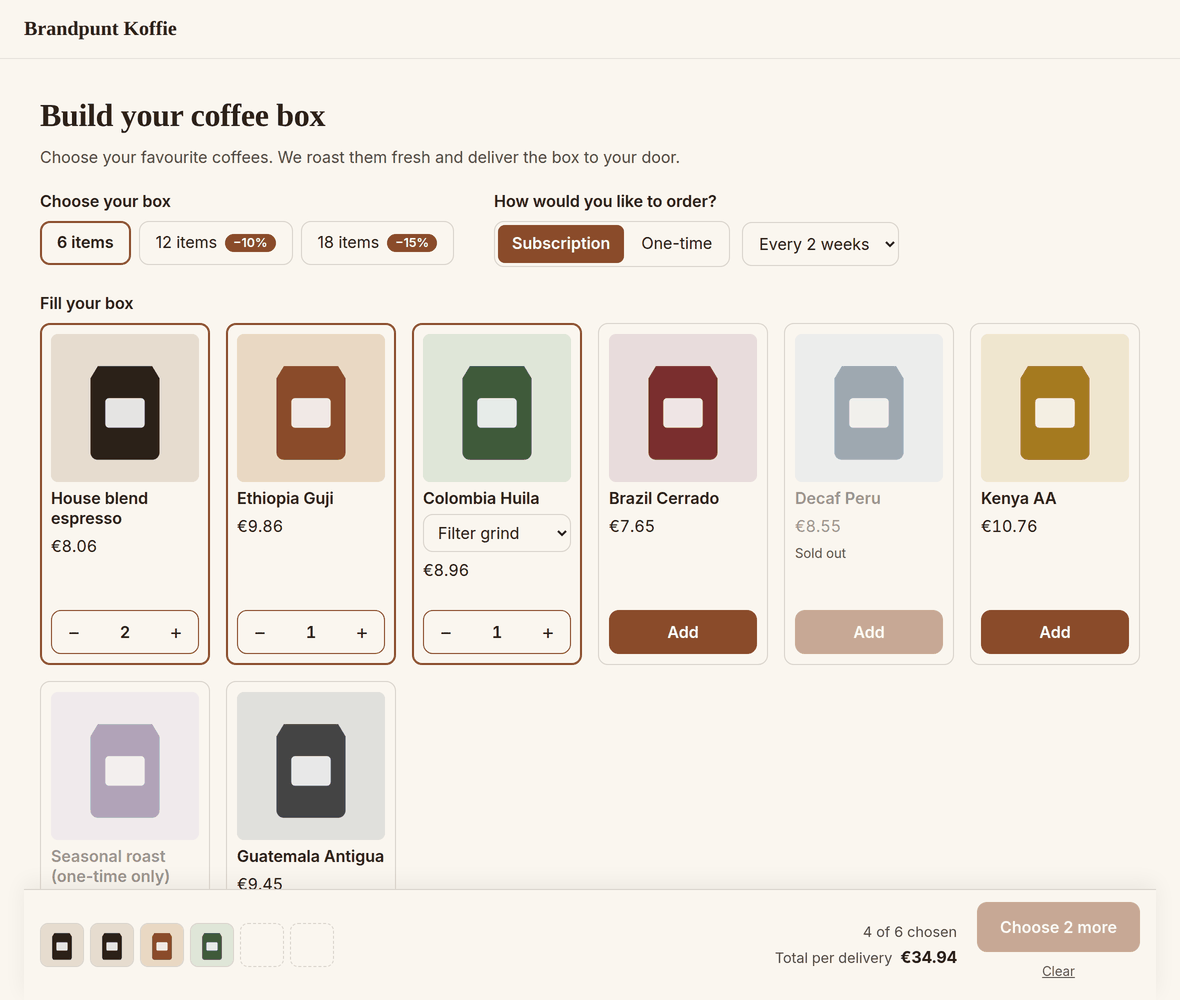
| Box the customer builds | With the box builder the customer chooses products from a collection, one-time or as a subscription. Per box you set up to 4 sizes of 2 to 48 products, each with a discount in whole percents. When the box is full and a larger size gives a higher discount, the page offers that size. A fixed price per box is not possible |
| One-time extras | A subscriber adds a single product to the next delivery in the portal; it is charged with that delivery. You choose the products, an optional discount and the maximum per delivery |
| Reward with a minimum | Per reward you set a minimum order amount |
| Free shipping | You set the threshold in your shipping settings in Shopify. Loyalo can show a progress bar to free shipping in the cart; you fill in the amount yourself |
Free shipping can also be a benefit of a tier. That customer then has no reason left to order up to your threshold, so take that into account. Product recommendations in the cart are not part of Loyalo; use your theme or another app for those.
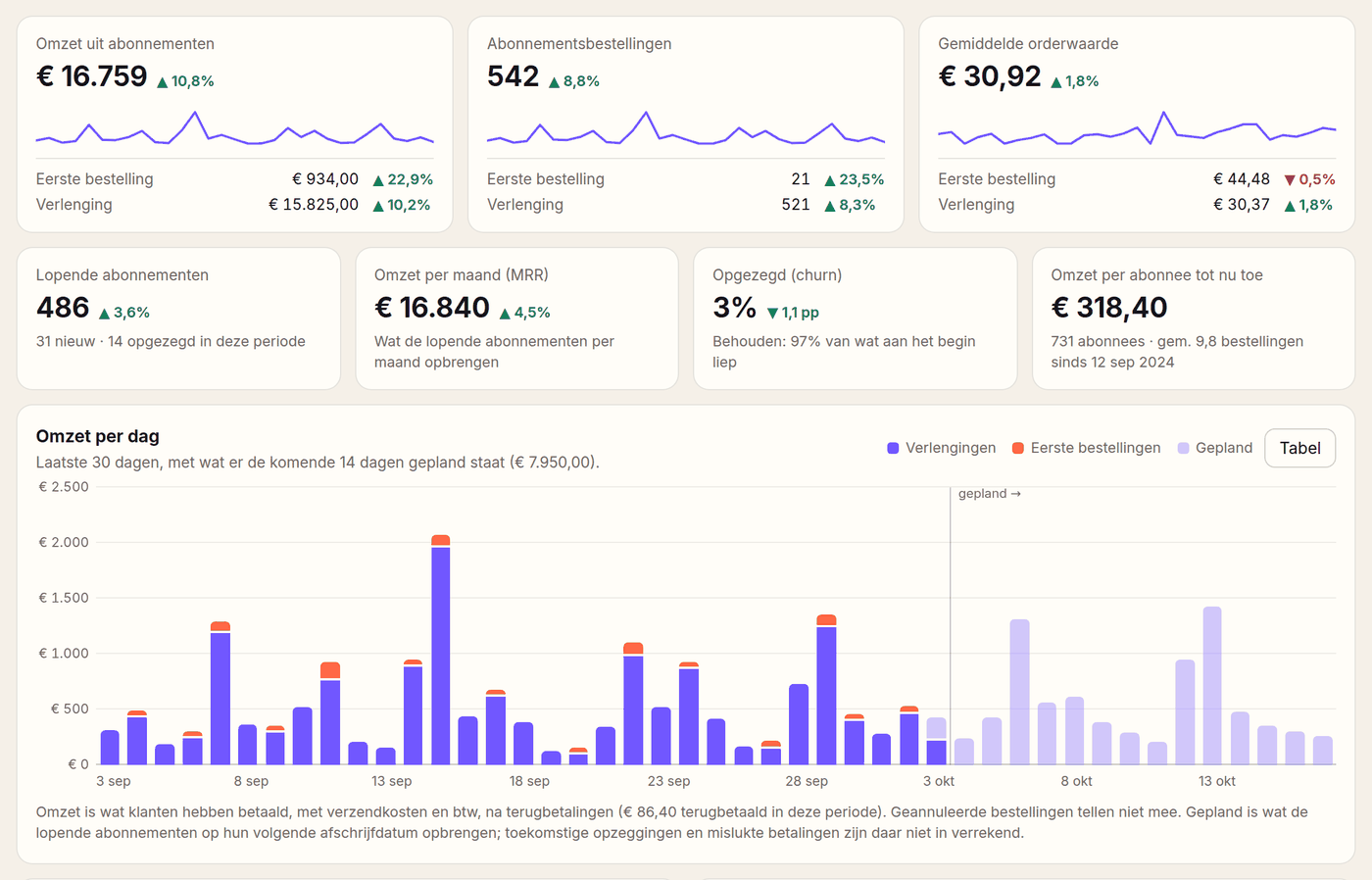
On the Analytics page, the Revenue tab shows the average order value of your subscription orders, with first orders and renewals apart and the difference with the period before. Loyalo calculates there with what the customer paid, including shipping and VAT, after refunds. One-off orders without a subscription do not count there.
Common mistakes
- Steering on order value without working out the margin per order, before and after.
- A threshold or step that most customers already reach. Then you give away a discount or free shipping without anything changing.
- A threshold that is too far away. If an ordinary order is € 25 and the threshold € 75, the gap is too large for most customers.
- One average for the whole shop. Subscriptions, one-off orders and business customers each have their own order value.
- Not checking whether the customer comes back later. Track the number of orders per customer as well.
Frequently asked questions
What is the AOV formula?
AOV = revenue ÷ number of orders. AOV stands for average order value. Both numbers cover the same period and the same group of orders, for example all one-off orders of a month.
How do you calculate average order value?
Divide the revenue in a period by the number of orders in the same period. € 24,000 in revenue from 600 orders gives an AOV of € 40. Decide beforehand whether you count shipping and VAT.
How do you increase average order value?
Give the customer a reason to put more into one order: more items (a volume discount, a larger pack), another product (a bundle, a box, a recommendation) or an amount to reach (free shipping, a reward with a minimum). For every measure, work out what is left per order.
What is a good average order value?
There is no norm. The amount depends on your product, your prices and your customers. Compare with your own earlier periods and with your costs per order: the figure is good when enough is left after those costs.
Does AOV include shipping and tax?
That is a choice, and not every report makes the same one. Check how your reporting calculates the figure and only compare figures calculated the same way. For a calculation with margin, use product revenue without VAT or sales tax.
AOV or customer lifetime value: which matters more?
Customer lifetime value, because it counts all orders of a customer. Order value is one part of it, next to how often and how long a customer orders. A measure that raises the order value and lowers the number of orders can bring in nothing on balance.
More per order in your own shop
In a demo we show how volume discounts, the box builder and one-time extras work in Loyalo.
Request a demo