What is B2B customer loyalty?
B2B customer loyalty is the extent to which a business customer keeps ordering from you, even when another supplier makes an offer. You see it in companies that come back year after year, place a larger share of their purchasing with you and recommend you to others in their trade.
That is not the same as loyalty among consumers. A consumer decides alone and often in the moment. With a business customer it is different:
- Several people order for one company. The customer is the company, not the person who logs in
- Prices are agreed per customer
- Orders are larger and repeat at a steady pace
- The customer pays on account, with payment terms
- The buyer has to be able to justify choosing you with price, delivery and convenience; impulse hardly plays a part
That is why a points scheme for consumers does not automatically work for companies. How to set one up for consumers is in the article on creating a loyalty programme, among the related articles below this page. This article is about the business side: offices, hospitality, salons, practices and resellers.
Why B2B customers stay or leave
A business customer stays as long as ordering from you is less work and less risk than switching. Four things decide that.
| What counts | Why a customer stays | Why a customer leaves |
|---|---|---|
| Reliable delivery | The order arrives on the agreed day and is complete | An office without coffee or a salon without stock soon looks for another supplier |
| Easy reordering | The same order is ready in a few clicks, or arrives by itself | The buyer has to find the products and fill in the quantities again every time |
| Price agreements | The agreed price is already in the shop | Prices change unnoticed or have to be asked for with every order |
| Service | There is one point of contact and a mistake is put right quickly | Questions go unanswered and the customer has to chase them |
Discount is not on this list. A customer who only comes for the price also leaves for the price. What you set up below only works once delivery and service are right.
Five ways to keep business customers
Keeping customers in B2B comes down to agreements that make ordering easy and reward staying. The first three ways are about convenience and a clear price, the last two reward what a customer spends over a longer time. You can combine them.
| Way | How it works | When it fits |
|---|---|---|
| Standing order | The same order is placed automatically on a fixed rhythm, on account | The customer uses the product at a steady pace: coffee, pet food, consumables |
| Volume discount | From a certain quantity a percentage discount applies | You want customers to order more at once |
| Price agreements per customer | Every customer sees their agreed prices in the shop. In Shopify B2B those are in the company's catalog | Large customers and resellers you negotiate prices with |
| Tiers on yearly revenue | A company reaches a level based on what it spends in twelve months and gets fixed perks with it | Many business customers of different sizes, when you do not want to negotiate with each one separately |
| Points | The customer gets points per euro spent and redeems them for a reward | Small business customers where the owner places the orders |
Points do not suit every business customer. They work for small customers who order themselves: the owner of a salon or a lunchroom benefits from the reward personally. They fit less well with large customers on contract prices: the price has already been negotiated, and points on large orders give a lot back on top of that price.
In a larger organisation an employee orders with the employer's money, and an organisation like that may have its own rules about what employees can accept from suppliers. So make the benefit something for the company, such as a discount on the next order or free shipping, and not something for the buyer personally. When in doubt, ask what the customer's rules allow. This is common sense, not legal advice.
B2B loyalty programme examples
The shops in these four examples of a B2B rewards programme are made up, and so are the numbers. They show how the choice follows from the kind of customer.
| Shop and customer | What the customer gets | Why it fits |
|---|---|---|
| Brandpunt Koffie delivers to offices | A standing order every two weeks, on account. Volume discount: 5% from 12 bags, 10% from 24 bags | An office uses coffee at a steady pace and the office manager does not want to have to think about it |
| Trouwe Poot delivers to boarding kennels | Tiers on the revenue of the last 12 months: Silver from € 2,500 with 3% off, Gold from € 7,500 with 5% off and free shipping | A kennel orders all year, with a peak in the holidays. The yearly total says more than a single order |
| Studio Huid delivers to salons | Points at a rate of their own: 1 point per euro and € 25 off for 2,500 points, so 1% back. Consumers in the same shop earn 5 points per euro | The owner of the salon places the orders. The lower rate fits the trade price salons already get |
| Vitaal Dagelijks delivers to practices | Prices per practice, agreed for a year, and a standing order every month. No points | A practice works with a fixed purchase price, and a benefit for the practice fits better than a reward for the employee who orders |
Brandpunt Koffie and Vitaal Dagelijks do not reward with points, but with convenience and a fixed price. That is a loyalty programme too, only without a points balance.
How to set it up in six steps
- Decide who counts as a business customerLay down which customers count as a company: companies with a business account in your shop, or customers you mark as such yourself.
- Choose what you rewardReward revenue per year, not the single order. A company that places a small order every week brings in more over a year than a company that places one large order.
- Choose the benefitA discount, free shipping, longer payment terms or priority when stock is tight. Choose something you can pay for out of your margin.
- Show the customer where they standPut in the customer account and in your e-mails which price, which level and which benefit apply. The buyer has to be able to explain it inside their own company.
- Make reordering easyOffer a standing order and a button to repeat an earlier order.
- Measure per companyTrack per company whether it keeps ordering and what it spends per year.
What to measure
You measure the loyalty of business customers per company, not per person or per order. There is no norm: compare with your own figures from a year earlier.
| Figure | Formula | What it tells you |
|---|---|---|
| Repeat rate per company | Companies that ordered again this year ÷ companies that ordered last year | Which share of your business customers stays |
| Revenue per company per year | Business revenue in 12 months ÷ number of companies that ordered in that period | Whether customers place a larger share of their purchasing with you |
| Days between orders | Number of days in the period ÷ number of orders of the company | When the number of days goes up, the company is ordering less, or partly somewhere else |
A worked example with made-up numbers. Last year 40 companies ordered from you, and 34 of them ordered again this year. The repeat rate is 34 ÷ 40 = 85%. Those 34 companies and 6 new ones spent € 120,000 together this year. That is € 120,000 ÷ 40 = € 3,000 per company per year.
What a customer is worth over the whole time they stay is worked out with the formula in the article on customer lifetime value, among the related articles below this page.
How it works in Loyalo
Loyalo is a Shopify app for subscriptions, loyalty and standing orders. For business customers you set up the following:
- Who counts as a business customer. Contacts of companies in Shopify B2B, customers with a tag you choose, or customers you put in the group by hand.
- Points. The same number of points per euro as consumers, a rate of their own, or no points.
- Tiers. A series of tiers of their own for business customers, with a discount, free shipping and your own perks per tier. For revenue per year you choose amount spent over the last 12 months; for a period, Loyalo counts the orders it has processed itself.
- Volume discount. A rule for business customers only, with up to four steps. The step comes on top of the price from the company's catalog.
- Standing orders. On the agreed day Loyalo places a B2B order for the company location, at the prices from the catalog and on account, with the payment terms of the location.
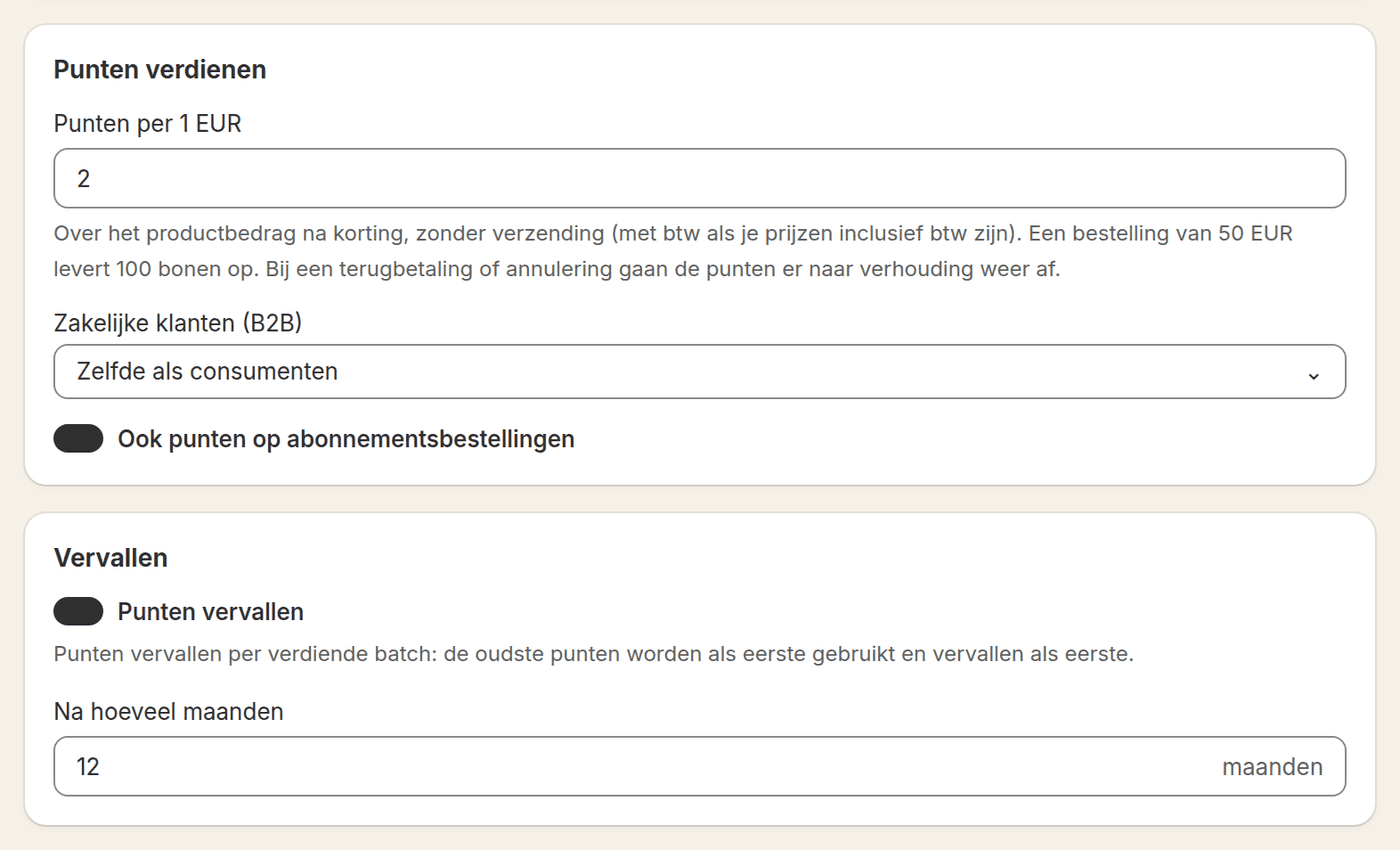
A volume discount and a tier discount do not stack: the customer gets the better of the two. Standing orders are part of the Scale B2B plan at € 499 per month and work with the companies, locations, catalogs and payment terms from Shopify B2B. Points and tiers belong to the Customer Loyalty add-on at € 199 per month, on top of a plan. Volume discount is part of every plan.
Common mistakes
- Switching the consumer programme on for companies unchanged, so large orders earn a lot of points on top of an agreed price
- Rewarding the buyer personally instead of the company
- Rewarding per order instead of per year
- Putting a volume discount on top of a contract price without checking the sum against your margin
- Giving a discount while the problem is in the delivery
Frequently asked questions
What is B2B customer loyalty?
B2B customer loyalty is the extent to which a business customer keeps ordering from you, even when another supplier makes an offer. It is about the company as a customer, not one person: often several people order, at agreed prices and on account.
Do loyalty programmes work for B2B?
Yes, but rarely in the same form as for consumers. Business customers place larger orders and often have their own prices already, so the same number of points per euro gives a lot back. Standing orders, volume discounts and tiers on yearly revenue usually fit better.
What are examples of a B2B loyalty programme?
A coffee roaster that gives offices a standing order on account, with a volume discount. A pet food shop with tiers on the revenue of the last twelve months. A skincare brand that lets salons earn points at a lower rate of their own.
How do you increase loyalty among business customers?
Start with delivery and service: that is what a business customer stays or leaves for. Then make reordering easy with a standing order and reward revenue per year with a volume discount or tiers.
Points or discounts for business customers?
A discount is usually clearer: the buyer thinks in unit prices. Points fit small customers where the owner places the orders. In a larger organisation, reward the company, not the buyer personally.
How do you measure B2B customer loyalty?
Per company. The repeat rate is the number of companies that ordered again this year, divided by the number that ordered last year. Also track the revenue per company per year.
Can a business customer take a subscription?
Shopify subscriptions do not work for business buyers. A standing order does the same in a different way: Loyalo places an ordinary B2B order on the agreed day, on account. That is part of the Scale B2B plan.
Keep business customers in your own shop
In a demo we show how standing orders, volume discounts and tiers for business customers work in Loyalo.
Request a demo